Motion Control Modules » Stepper Motor Drivers » MP6602 Stepper Motor Driver Carriers »
MP6602 Stepper Motor Driver Carrier
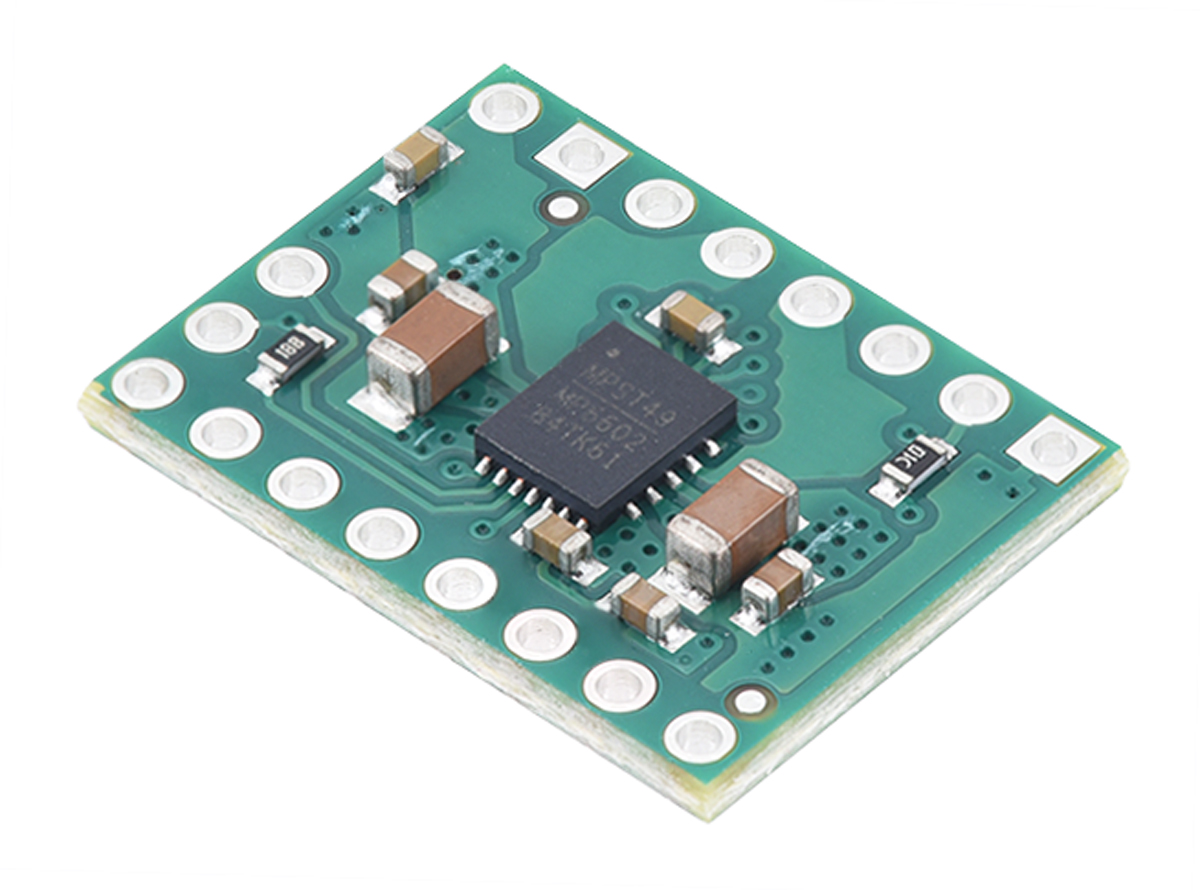
This is a breakout board for the MPS MP6602 microstepping bipolar/unipolar stepper motor driver, which features a serial interface and stall detection. It operates from 4.5 V to 35 V with a maximum current limit of 4 A, which it can run at continuously on our carrier board without a heat sink or forced air flow. The SPI interface allows configuration of the current limit, step mode (6 step modes from full-step through 1/32-step), decay mode off time, and stall detection, and it can also be used for stepper motor control. The driver also features built-in protection against under-voltage, over-current, and over-temperature conditions. This version does not include header pins.
Alternatives available with variations in these parameter(s): header pins soldered? Select variant…
 Compare all products in MP6602 Stepper Motor Driver Carriers or 16-pin Stepper Motor Drivers.
| Description | Specs (14) | Pictures (8) | Resources (6) | FAQs (4) | On the blog (0) | Distributors (7) |
|---|
- I want to control a 3.9 V, 600 mA bipolar stepper motor, but this driver has a minimum operating voltage above 3.9 V. Can I use this driver without damaging the stepper motor?
Yes. To avoid damaging your stepper motor, you want to avoid exceeding the rated current, which is 600 mA in this instance. All of our stepper motor drivers let you limit the maximum current, so as long as you set the limit below the rated current, you will be within spec for your motor, even if the voltage exceeds the rated voltage. The voltage rating is just the voltage at which each coil draws the rated current, so the coils of your stepper motor will draw 600 mA at 3.9 V. By using a higher voltage along with active current limiting, the current is able to ramp up faster, which lets you achieve higher step rates than you could using the rated voltage.
If you do want to use a lower motor supply voltage for other reasons, consider using our DRV8834 or STSPIN-220 low-voltage stepper motor drivers.
- Do I really need to set the current limit on my stepper motor driver before using it, and if so, how do I do it?
Yes, you do! Setting the current limit on your stepper motor driver carrier is essential to making sure that it runs properly. An appropriate current limit also ensures that your motor is not allowed to draw more current than it or your driver can handle, since that is likely to damage one or both of them.
Setting the current limit on the MP6602 is done through its SPI interface (this is very different from most of our other stepper motor driver carriers, which have their current limits set through their on-board potentiometers). The MP6602 defaults to a current limit of 1.25 A on start-up, which might be more than your stepper motor can safely handle, so we recommend setting current limit to an appropriate value for your stepper motor before enabling the driver outputs to prevent damage to the stepper motor. This is done by through the ISET register. The MP6602 datasheet (1MB pdf) and application note AN189 (1MB pdf) have more information on how to set the current limit through the SPI interface, and our Arduino library includes example sketches showing how to implement this in software.
- My stepper motor driver is overheating, but my power supply shows it’s drawing significantly less than the continuous current rating listed on the product page. What gives?
- Measuring the current draw at the power supply does not necessarily provide an accurate measure of the coil current. Since the input voltage to the driver can be significantly higher than the coil voltage, the measured current on the power supply can be quite a bit lower than the coil current (the driver and coil basically act like a switching step-down power supply). Also, if the supply voltage is very high compared to what the motor needs to achieve the set current, the duty cycle will be very low, which also leads to significant differences between average and RMS currents: RMS current is what is relevant for power dissipation in the chip but many power supplies won’t show that. You should base your assessment of the coil current on the set current limit or by measuring the actual coil currents.
- How do I connect my stepper motor to a bipolar stepper motor driver?
- The answer to this question depends on the type of your stepper motor and how many wires it has. We have an application note that details possible methods for connecting stepper motors to bipolar drivers and controllers and the advantages and disadvantages of each option.
Related products


Related categories


Home | Forum | Blog | Support | Ordering Information | Lists | Distributors | BIG Order Form | About | Contact
© 2001–2026 Pololu Corporation