Pololu Blog » Engage Your Brain »
Understanding battery capacity: Ah is not A
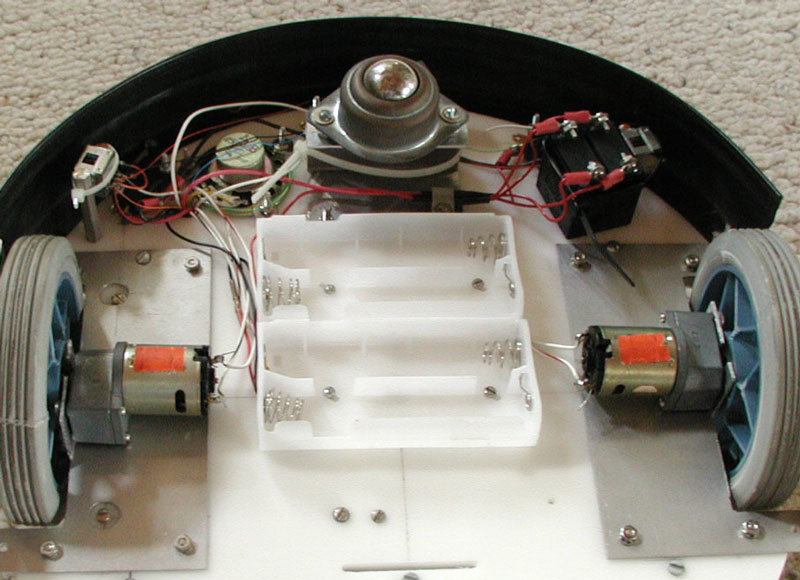 |
I used battery holders for eight “C” alkaline cells on my robot after not finding a 12V, 1A battery. |
|---|
My earliest electronics projects and my first robot were powered by regular alkaline batteries, and I didn’t think about current or the capacity of those batteries. The batteries were prominently labeled “1.5V”, and I was happy in my understanding that putting four in a battery holder got me to 6 volts; when the motors slowed down, it was time for new batteries. When I began designing my second robot, I found some 12V, 1A motors (what a “1-amp motor” might mean is a topic for another post) and promptly wasted many hours dragging parents and teachers to Radio Shack and car parts stores looking for a 12V, 1A battery. No one understood that the batteries were labeled with capacity, not current, and since the smallest 12V motorcycle and alarm system batteries in town were 3Ah or 4Ah, I went home empty handed. I ended up using alkalines. Apparently, once the battery capacity wasn’t in my face, I forgot about my concern that they would force too much current into my motors.
I made many common mistakes in going about my battery selection:
- Not understanding that my circuit would draw whatever current it wanted from the battery, as opposed to the battery forcing a given amount of current into the circuit.
- Thinking that my motors would draw a fixed amount of current.
- Confusing current and capacity.
- Ignoring the “h” in “Ah”
- Forgetting about a property, such as capacity, as soon as it wasn’t in my face.
The first two points are complex enough that further elaboration would merit their own posts; today I want to focus on some technical details of battery capacity and current and touch on the sloppy attitude that leads to the last two mistakes.
A battery stores energy; the “capacity” is how much energy it can store. Energy is measured in joules, abbreviated J, but it can also be expressed in different units such as watt-hours, abbreviated Wh (for larger quantities, such as residential electricity use, kilowatt-hours (kWh) are used; a kWh is a thousand Wh). This is similar to the way area can be measured in acres or in square miles: there are units specifically for area, such as acres, but you can also arrive at a measure of area by multiplying length by length, to get mile-miles, or the less awkward square miles. (The hyphenation imposed by English grammar does not help matters since the hyphen looks like a minus sign when we are actually multiplying the units together.) Watts and watt-hours are generally good units for electronics since they are easily related to voltage and current and since typical batteries that you can hold in your hand will have a capacity of a few dozen watt-hours.
In the case of a typical battery, where we can assume a constant voltage, we can replace watts with volts multiplied by amps. A 12-volt, 1 amp-hour (abbreviated Ah) battery and a 6-volt, 2Ah battery each store 12Wh, but the voltage is usually a critical parameter for a battery, and once a voltage is selected, the capacity can be specified by the amp-hour rating. The value in using the amp-hour is that it makes explicit our multiplication of rate, the amp, and time, the hour: a battery rated for one amp-hour can provide a current of one amp for about one hour, two amps for about half an hour, or 0.1 amps for about ten hours. I say “about” because the exact capacity will depend on the current.
The current and capacity for a battery are like the speed and range of a car. If your car has a range of about 300 miles, you can go 30 miles an hour for ten hours, or 60 miles an hour for five hours. Your efficiency will get worse with speed, so by the time you go 60 miles per hour, you might run out of gas after only four hours, for a range of 240 miles. Going back to my battery search, looking for a 1-amp battery was like looking for a car with a speed of 60 miles: 60 miles isn’t even a speed, and even if I revised my search to a car that could go 60 miles per hour, it still wouldn’t be a useful specification to look for. Most batteries on the scale I was looking at can deliver one amp, just like most cars can go sixty miles per hour. The maximum available current, like the maximum speed of the car, might be a more reasonable specification to search for, though providing those kinds of specifications might make the respective manufacturers nervous.
It is reasonable, though, to consider the maximum current a battery can safely deliver. That value will depend on all kinds of things, including the chemistry of the battery, but the maximum discharge rate is almost always tied to the capacity. That means that given a particular technology, a battery with double the capacity can deliver double the maximum current. Batteries are often specified with a discharge rate in terms of C, where C is the capacity of the battery divided by hours. For example, for a 2Ah battery, C is 2A. If the battery has a maximum discharge rate of 10C, the maximum current is 20 amps. It’s good to keep in mind that a 10C discharge rate means a battery life of less than 1/10th of an hour, and with the loss of capacity that a high discharge rate generally causes, the battery life would be less than five minutes.
As I tried earlier to recall what happened with my failed battery search, I was struck by the extent to which I ignored the “h” in the “Ah” specification and the ease with which I forgot about my critical “1-amp battery” requirement when I returned to the alkaline batteries. Unfortunately, this kind of carelessness or sloppiness is common, especially for beginners who might already be overwhelmed by all the information they need to sort through and who have not yet had the experience of losing time and destroying hardware because of inattention to details. I do not have any particular solution to this problem beyond reminding you to pay attention and think about how things should work before just hooking things up. Be on the lookout for contradictions; seeing “Ah” where you expect “A” should definitely make you very uneasy and lead you to reevaluate your expectations.
I will wrap up this article with some example battery capacities.
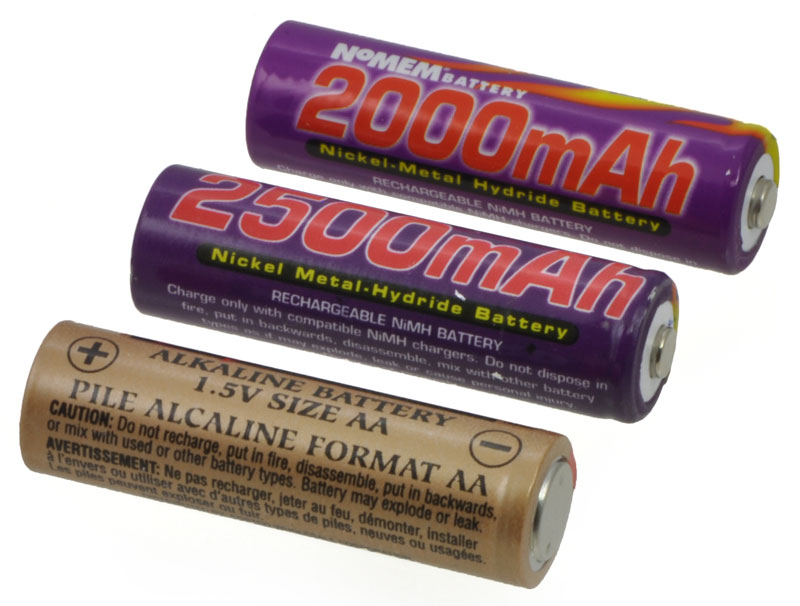 |
AA batteries. |
|---|
- A typical alkaline or NiMH battery in the standard “AA” size has about 2000 to 3000 mAh (or 2 to 3 Ah). With a cell voltage of 1.2 V to 1.5V, this corresponds to 2 to 4 Wh per cell. When multiple cells are used in series, as with the use of a battery holder or most pre-made battery packs, the voltage goes up but the capacity in amp-hours stays the same: an 8-cell NiMH pack made of AA cells will have a 9.6 V nominal voltage and a 2500 mAh capacity. There can be quite a range in capacities depending on the quality of the batteries. For larger cells, such as C and D size, the capacity should go up approximately proportionally to volume, but some cheap units (they’re usually light) can have the same capacity as the smaller cells. Alkaline cells have a more pronounced drop in capacity as the current drawn out of them goes up, so for applications requiring several hundred mA or more current, NiMH cells of the same size could last significantly longer. For low-current applications that need to run for months, alkaline batteries can last much longer because NiMH cells can self-discharge in a few months.
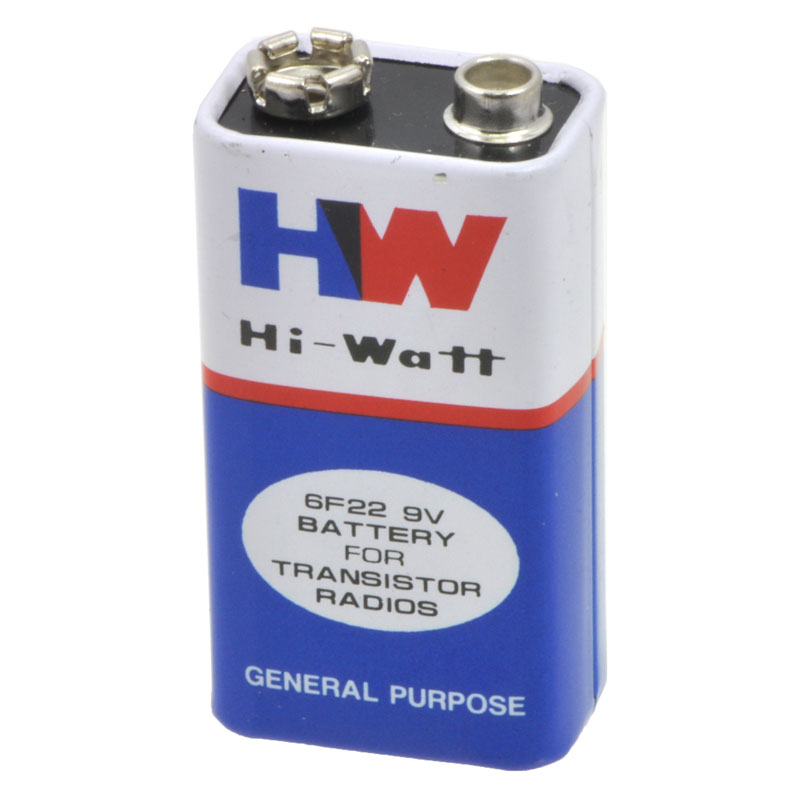 |
9V battery. |
|---|
- 9V alkaline batteries can be convenient for their high voltage in a small size, but the energy density (watt-hours per given volume or weight) is the same as other batteries with the same chemistry, which means the capacity in amp-hours is low. In approximately the same size as an AA cell, you get six times the voltage, so you also get about six times less in the Ah rating, or about 500 mAh. Given the high losses incurred from discharging in anything under a few hours, 9V batteries are impractical for most motors and therefore for most robots.
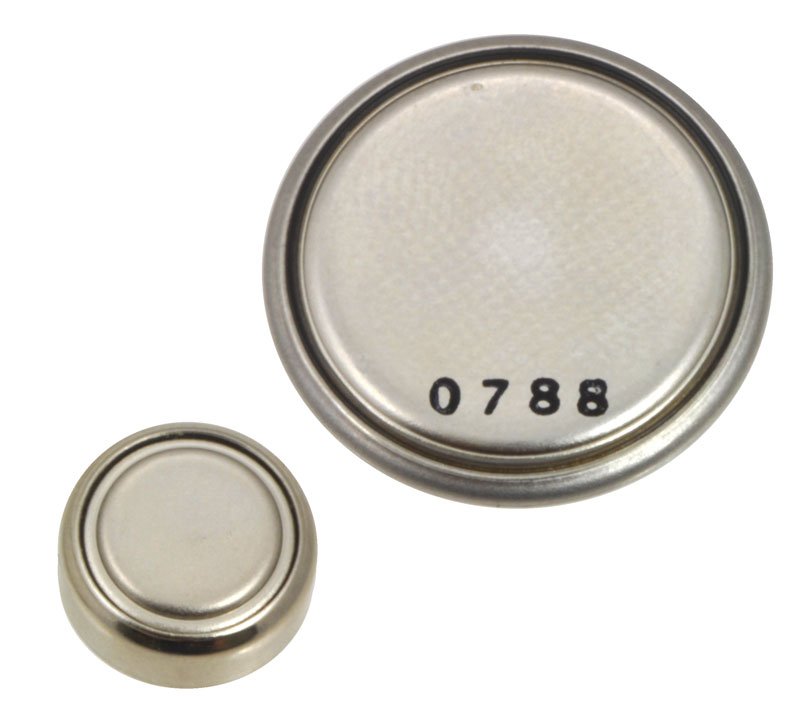 |
Coin or button cell batteries. |
|---|
- Coin or button cell batteries vary in size and chemistry, but you can generally expect 1.5 to 3 volts with a few dozen to a few hundred mAh.
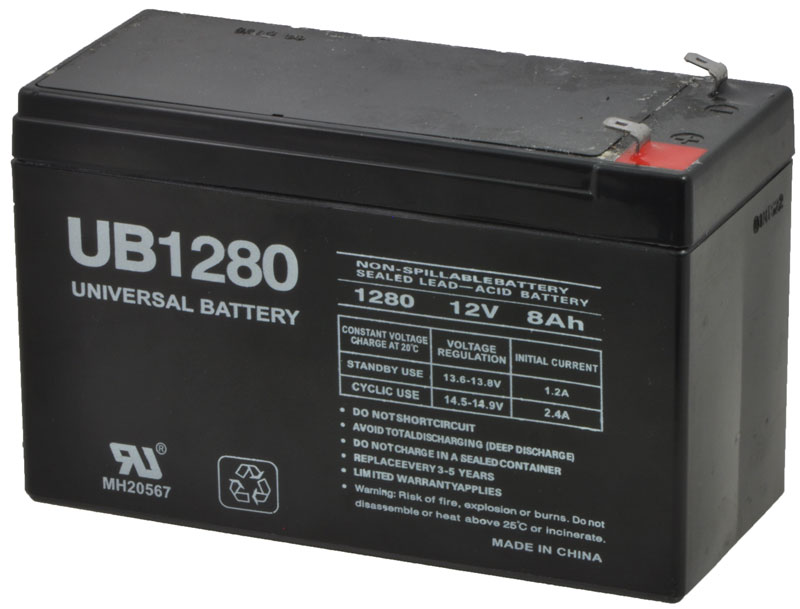 |
12V, 8Ah sealed lead-acid battery. |
|---|
- Lead-acid batteries are popular for larger projects since they are usually the lowest-cost option and are widely available. Sealed lead-acid or gel-cell batteries are available in 6 V and 12 V versions (other multiples of 2 can be found), with the 12 V versions weighing about a pound per amp-hour. 12 V car batteries store a few dozen amp hours, and they weigh a few dozen pounds.
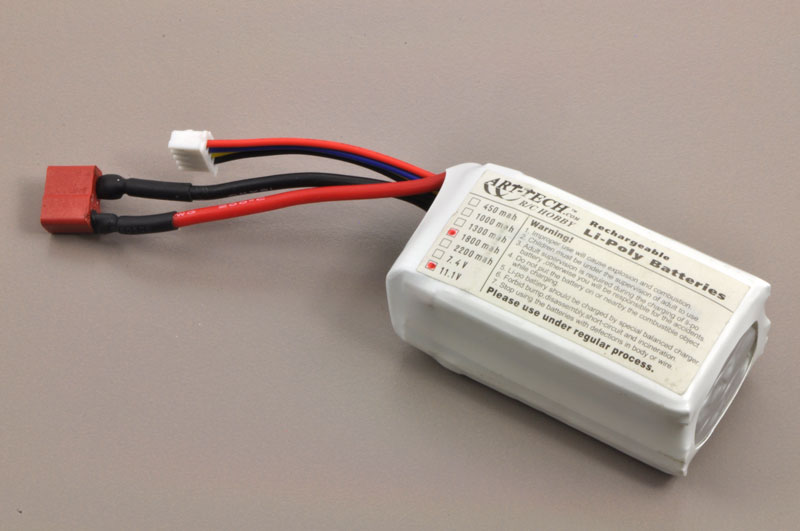 |
11.1V, 1800mAh Li-Po battery. |
|---|
- Lithium-based rechargeable batteries have around double the energy density of alkaline and NiMH batteries by volume and even better improvements by weight. These newer batteries are far less standardized in terms of battery size and shape, but since they are usually intended for applications where capacity or maximum battery life are important, these batteries usually have their voltages and capacities prominently labeled.
-

Introduction to Jan's blog
- 12 November 2010My name is Jan Malášek, which is a Czech name, so the “J” is pronounced as an English “Y” (if you care, we can go over the last name in person, or...
-
Know your units
- 19 November 2010How many volts of current are there in a bolt of lightning? That’s the kind of stupid question your local news anchor might ask while bantering...
245 comments

It's probably worth noting, particularly for lead-acid batteries, that the capacity is usually listed assuming that the battery will be discharged over a 20 hour period. If you're using it in relatively high current applications (i.e. robotics or motors of any kind) then you can expect almost half of that. This is something that caught me out when I was looking at battery options.

- Jan


Es un buen escrito para los nuevos constructores de robots.


You wrote
"Most batteries on the scale I was looking at can deliver one amp..."
How many amps can a single AA battery deliver?
I want to run a 1 amp (12v, 15 watt max) motor at low rpm (as part of a solar tracker prototype) using rechargeable AA NiMH.
How many 12 volt arrays in parallel needed to draw current adequate to move a panel (other than trial and error)? Let's say a panel weighs around 10 pounds (or 5kg).
10 AA's @ 1.2v in series gives me 12v, but I don't think I can run a 15 watt motor with it. Do I need 10 more batteries in parallel? 20 more?
And what is/are the unit/s for maximum (or optimal/safe) discharge rate? I guess it doesn't come up for AA batteries much. Though some of the electric car companies are making their batteries similarly, and laptop batteries are similarly configured (10+ cells computed to get to the right balance of watt-hours and current-draw).
Most NiMH chemistries will probably tolerate at least a few C discharge rate, so an AA should be able to deliver at least 5A, which is plenty for the motor you're describing.
I have no idea what you're asking with this solar stuff, probably because you have little idea. Among your likely confusions: weight is not at all enough to tell us how much power you need, and getting more current available in your batteries is not going to force more current into your motor.
You should not be putting batteries in parallel unless you really know what you are doing, which in this case you do not.
Maximum, optimal, and safe discharge rates are completely separate. Any maximum rating better still be safe, and there will be a wide range of safe discharge rates. Optimal in terms of energy delivered will probably be around a few mA over a month, maximum could be 20A for a few minutes.
- Jan

I can only find 12v 12Ah or 12v 15Ah. Would using batteries with different Ah than the originals be a problem?
- Jan

Ok, since I'm newbie please be patient...
I'm going to buy a 24 channel RC servo controller and for sure I'd want to add to the combo, the most suitable battery pack option for the better and worst case (which is 1 Servo or 24 at the same time). Let's say that the servo I'm interested in is the famous Hitec HS-311.
Hitec specs that this servo will drain 7.7mA iddle / 160mA no load (normal working?) at 4.8v and 7.7 mA iddle / 180 mA no load (normal working?) at 6.0v.
Please, correct me if I'm wrong with the following assumption:
if I plug 24 servos, I'll need a battery pack capable of deliver 6v 4320 mAh in order to have all servos working for just one hour...
If I plug just 1 servo, since I'd need just 180mA, my new hypothetical battery will power it for 24 hs.
Which is the most suitable battery pack in sale here that would you suggest for this example?
Many thanks in advance!
Nico.
Your basic math is right, but keep in mind that capacity depends on discharge rate, so depending on the battery and how it's rated, it might not necessarily give you the 4320 mAh if you discharge it at 4.3 A. We do not carry any packs with that high of a capacity, but that's in the range of what you would get with "C" sized NiMH cells. You should be able to find receiver or servo packs with that kind of capacity at a hobby store (a quick search at Tower Hobbies led to http://www3.towerhobbies.com/cgi-bin/wti0001p?&I=LXVTG1&P=7 ; at first glance, it might be what you're looking for). You could also consider lead-acid batteries; they will be bulkier, but they will probably be cheaper and easier to find in capacities exceeding 4Ah.
- Jan

- Jan

I just happened to stumble across this post in my search to find out about maximium current draw for Ni-MH AA batteries i have two applications i am going to use. Correct me if I am wrong but I currently understand that if I have equipment that requires a voltage of 6v and a current of 1amp that (as you said) I will need 4 AA batteries (alkaline 1.5v) to get 6v and these should provide the 1amp comfortably! But if I have 4 AA Ni-MH batteries (1.2v) I am only getting 4.8v! I am under the impression that as the voltage is lower than required, it tends to draw more current to make up for the voltage drop!
I am thinking like this as I have been testing RC Toy Car run time with alkalines and then swapping out for Ni-MH (2500mah uniross) and there doesnt seem to much difference in the run time,there was only a 23mins extra with the Ni-MH!
Application 1
I am a plumber and I am constantly working in roofspaces and small dark places so I really hate it when my torch dies and i have to go to the van to get a 240v light lead!(the torch never gives enough light anyway)
i have went down this road before and i rigged up a small 12v 10watt (900mah) LED to my ryobi torch! This works quite well and give brilliant light but the rechargeable batteries for my ryobi are expensive and i need them to power the rest of my tools!Plus they will only run this LED light for around 1hr 15mins (with 45min recharge time)
I have been researching plenty of high output LEDs but anything over 3watt and it needs a heatsink so i have been reduced to smaller LEDs. So instead of 10 x 12v 3watt i am going with 10 units of 12v x 48 SMD LED that each draw less than 1watt (10watt maximium) not sure what the mah is yet still waiting on delivery so 480 SMD LEDs in total!!
I am quite confident that these will run fine on 10 AA Ni-MH batteries, but as I dont yet know the current draw for each set of leds I cant be sure of how long it will last. Am I right??
Application 2
This is where I need advice on the Maximium Current draw of a 2500mah uniross AA Ni-MH battery. I am only being specific as these are the batterys i have found to be most reliable and i have plenty to hand!
I bought a set of xenon bulbs for my old car (Rip Corsa) and i have now got a new car but the bulbs do not fit so instead of throwing them out (because no-one would buy second hand) i was thinking again of using 10 x AAs to get my 12v but i know that the ballast unit that starts the bulb needs a minimium of 6/7 amps for a split second to ignite the light once it is lit the bulb will only draw 2/2.5 amps. These bulbs run equivalent to 150watt halogen bulb or 3200-3500 lumens!!
So my real question is can an AA battery push out to 7 amp maximium and if it can, would prolonged use or this type of ignition for a light destroy the batterys?
For this application I am only looking to use for a flashlight! (ie not a very long run time maybe 15-20mins)
I Know I can ramble on but i wanted to give as much information as possible so you understand in full the purpose of my application!!
Thanks for taking the time to read this post!!
You're kind of all over the place there, so I will just give you bullet point comments as I go through your post:
* I don't know where you're coming up with this "(as you said)" note.
* All kinds of devices (including motors and light bulbs) draw less current when you give them less voltage. You have to have some somewhat special electronics to draw more current when the voltage goes down. Some LED flashlights could certainly be in the "somewhat special electronics" category.
* I'm used to RC toy cars running for maybe 10 minutes, so 23 extra minutes is huge. Obviously, it's not in your case, but you should see it's useless for you to just mention 23 minutes without some baseline.
* Your Application 1 text is difficult to follow and seems to have a lot of extra unnecessary details.
* If you are asking for confirmation that you cannot calculate the battery life without knowing the current you are drawing, then yeah. But in that case, I don't know where you are getting your confidence about running off a particular battery configuration.
* If 1W is your input power at 12 V, you can figure 1/12 A (or 83 mA) for your current.
* I don't think a lot of little LEDs is an efficient way to get a lot of light. That's based on the good flashlights not seeming to do that.
* I expect a decent AA NiMH cell to be able to put out 7 amps for a few seconds, but if you really care, you should try to get the specs for your particular batteries.
- Jan

is it true batteries are like memory cards or hard drives?
e.g. when you buy a 5gb memory card the usable space will be far less than the 5gb capacity.
if that is true,how can you compute the usable power vs the mah rating of lithium ions?
thank you :D
I don't think your statement about memory devices is correct. The battery part is in the post: as with range on a car, you will get more or less out of a battery depending on how quickly you try to get it out.
- Jan
let me just rephrase the memory card/hard drive analogy: :)
I bought a portable terabyte drive disk,its advertised as 1000gb but when you are about to check the fresh unused drive, it only has 930gb usable free space even without putting any files on it.
reference (see comments) http://news.cnet.com/2100-1015_3-6105515.html
I was wondering if this also applies to batteries,ie: if you buy a 200mah battery will you also get a full usable 200mah?
cheers! :)
Anyway, there's no equivalent issue with mAh as far as the unit goes. The point is, as with the MPG on a car, you can't capture the capacity with a single number. I think that with most reputable battery manufacturers, you will get the advertised capacity if you suck the power out at the right rate. If you discharge the battery quickly, over something like an hour, you will likely get less than the nominal capacity; if you draw it out over something like a week, you will probably get more. If your applications always discharge the battery quickly, it's reasonable to expect that you'll always get less than the claimed capacity.
You might think of something like ketchup in an 8 oz. bottle: there's 8 oz. there, and you can get it all out if you wait long enough, but you'll get a lot less if you only have 5 seconds per bottle to get it out.
Of course, keep in mind there are many more variables with batteries, like how much that capacity changes over the number of times you recharge, how the temperature affects the capacity, and on and on.
- Jan
this is getting interesting..
so it all depends on the sucking or pulling of the reciever.
sample items:
a portable external battery charger w/ 100mah rating
a gadget w/ 20mah rating
(figures above are simplified,not real ratings)
the gadget can get 5x from the charger at a right rate.BTW the gadget is on 'off' mode while charging.Is my approximation correct?
do you have a formula for the speed of charger drain using the pairing sample above?
other non battery info that might help.
charger's charger rating:
input: AC 100-240v 50/60hz 150mA MAX
output: DC 5.3V 1000mA
gadget's charger:
input: 100-240V 50/60hz 0.5A
output: 5.0v 2.0A
all the best :)
Please forgive my noob assumptions..
Using your ketchup analogy & lithium's hard drive analogy
When you buy an 8 0z ketchup (or 8mah battery) you will get a bottle filled w/ 8 oz ketchup (or 8mah battery energy).
So the Hard drive industry is different from the battery industry.
Hard drive industry: you get LESS on what you pay for.
ie: buy 10gb,but 9gb is only usable
Battery industry : you get EXACTLY what you pay for
ie: buy 10mah battery,you get usable 10mah power.(either slow or fast suck).
???
With the hard drive, you make a mistake when you switch from what you get to what you use. You buy 10gb, and you get 10gb; how you or your device use it is a separate thing. When you buy an 8.5 x 11 inch piece of paper, that's what you get, even if your printer can't print on the whole area.
- Jan

I have a simple question about batteries:
Discharge Rate: Fixed 5V, 1,000mAh
Charge Rate: 5-5.5V 450mAh
the unit mAh is a unit of electric charge, like Coulomb. I don't understand what a fixed 5V discharge rate means. Also what does the 1000 mAh mean?
Why does the charge rate have a smaller mAh?
Thanks,
Kavan
I can confirm that your two specs do not make sense. Without any context, it's difficult to guess the intended meaning.
- Jan

You are not providing the right kind of information to answer your questions, and I do not know if this is the appropriate venue for going into the details of your project. But, here are some general points that might be helpful to you and others:
* I think 2.5 years is unlikely to be practical for a rechargeable battery. (Maybe that was a typo since "charging" and "changing" are pretty similar.) I think there are various non-rechargeable battery types, like lithium batteries, that are supposed to last a decade or more.
* It is not helpful to go into details like how many characters are sent without talking about the time it takes. And, for all I know, the wakeup and autosleep stuff might take longer than sending the message. Anyway, let's say your power requirements are 2A for 5 seconds every day. You would need 2 A x 5 seconds = 2.8 mAh per day. Multiply that by 365 and then 2.5, and you get to a little over 2.5 Ah for your 2.5 years. That's not some particularly huge number, though you might need to pad it quite a bit since the capacities might be based on very low discharge rates, not the 2 A pulsed discharge.
* How do you expect anyone to know the "best alternative" for your application? We cannot know if your system will be in the sunlight for some solar option or how practical it is to power your system from a wall outlet.
- Jan
Thanks a lot for your response! Sorry for not providing proper information. Firstly, the battery cannot be re-chargeable. Secondly, I wanted a very small circuit, hence no scope for recharging. Also, the size of the end-product should be as small as possible.
Thanks for those inputs like wakeup and autosleep taking longer than sending the message. Yet, would a 2.5Ah non-rechargeable lithium battery suffice my purpose of lasting 2 years at least.
I am sorry if this is not the forum for this discussion. You may please let me know the same and i shall post this info there. If you need more inputs, i am ready to share them.
Best Regards
Anand
- Jan

The fact that the capacity is never mentioned on Alkaline batteries is driving me nuts… It's arguably the most important criteria of a battery… Instead they push marketing slogans like "last twice as long as other batteries"… Why not simply give the capacity so everybody can see for himself ?
I think it should be mandatory. Imagine if you bought a bottle of water and they wouldn't tell how much water is inside…
I'm not sure what you mean by "mandatory", but in the typical, government-backed sense, that is a very bad thing. Imagine if you bought a bottle of water without knowing how much water was in there and someone put you or the seller in prison.
If you're just talking about making a capacity specification a personal prerequisite for you to consider buying a battery, keep in mind that there are all these other variables, including discharge rate, temperature, how old the battery is, how low the voltage can be before you consider it discharged, and on and on.
- Jan

- Jan


I have an old but nice Bosch cordless drill/driver (PSR 7,2 VES). It's one of the Swiss made ones! The battery pack is a Ni Cd 7.2V and rated 1.4Ah. The replacement cost is £57.
So if I make an assumption that were I to run the drill constantly (which you can't because it would overheat) it should run for maybe 20 minutes? That gives me a rough guess figure of 4.2 amps constant current?
I am thinking that if I were to fabricate a simple AA size battery holder, in place of the original battery, I could use 6 in series Ni-MH 1.2V - 1900 mAh AA batteries (Panasonic Evolta)? A value for C of 2.2 using my guess.
Is the above reasonable? I think it worthwhile to save a good drill from the landfill. Note to gearheads etc.: I know a 7.2V drill is probably considered a toy but I find it useful and it's what I have. I'm not in the market for something like a DeWalt at many £100s!
--
Stephen
That generally sounds reasonable. The current at peak loads might be higher than what you calculated, so the performance you see in the max torque sense could be lower that what you saw with the original NiCd pack (when it was new). I have no experience with the Panasonic Evolta, but if the performance ends up being limited, you might look around for NiMH cells that are better about high discharge rates.
Also, you probably should not use the original charger for the new NiMH pack.
- Jan
Your point about not using the original charger is taken. I intend to assemble the new pack in such a way as to be able to remove the batteries individually and use a brand AA charger.
Just to share the information: the Panasonic Rechargeable Evolta advertise as purposed for long term storage quoting 80% capacity after 1 year. I wonder if this is some 'new' variant of Ni-MH as the chemistry much be different to enable that long term storage of charge. Anyhow, perhaps a debate for another venue.
I will look out for further information about discharge rates. Best wishes for the success of Pololu and your team.
--
Stephen

vinnythestick@gmail.com

http://www.intorobotics.com/guide-to-choose-suitable-battery-to-build-a-robot/
http://www.onlinetps.com/forum/index.php?topic=29.0
http://vsblogs.wordpress.com/2012/02/09/select-the-right-battery-for-your-robot-dc-motors-part-1-of-2/

Please guide me I am a student and currently working on a Self Balancing Two Wheel Robot System, using a NI board which works on supply of 9-30Vdc. Power requirement is 24.7W. Kindly let me know what all things I have to look for while selecting battery and what about current and capacity? (I calculated current to be 2.74Amp)
Other thing I want to know is how to convert my Ampere value to Ah. In my case 2.74Amp=?? Ah.

The following is 'exempt' from the need to obtain a building permit in Ventura County, Ca. :
"8. Electrical wiring, devices, appliance or equipment operating at less than 25 volts and not capable of supplying more than 50 watts of energy." ((this is also found in building codes across the country)
I drew a 12v solar power system with a 12v battery and fuses that are 4amps, therefore limiting the output in any circuit to 48 watts.
I met with the head of the department of Building and Safety, and he says that NO part of the system may have the capacity to supply power greater than 24v, or 50W. Therefore, the solar panel must be no larger than 50 watts.(easy enough) But when it comes to the BATTERY, (for nighttime use) I can't figure out what to use. If the 12v battery discharges more than 4.1 amps, it puts out more than 50 watts. So- I can't figure out how to construct an exempt, 12v system. (I am going to power 5Watt L.E.D. bulbs, so I could power one for 10 hours, or 2 for 5, in theory, with 4 Ah))
Do you have a suggestion as to how to satisfy the requirements for exemption? (what battery to use, or how to satisfy this beaurocrat some other way)
Thanks- David dfeigin@yahoo.com
Did you read the post? Or the comments? Your question is answered many times.
- Jan
I'm not sure what you are asking. Is your safety guy saying the fuse approach is not acceptable? If you're thinking about using a 12 V lead-acid battery, those are commonly used in alarm systems, and I doubt they all need to get building permits. If they do accept the fuse or other current/power-limiting device right at the battery, the capacity shouldn't really matter, and you could use a 40 Ah battery (it would be the size of a car battery) to give you 4 A for 10 hours.
- Jan

I read the article and comments and I think I now understand the difference between A and AH.
I have a little question, I want to power a tripath amp. Input is 20V and current is 3A. I'm thinking of connecting 2x12V SLA batteries inline and they each have a capacity of 12AH. The batteries have "Initial current: less than 3.6A" written on the side. If I've got this right I should expect about 4hrs usage out this setup, where I'm a bit confused is that the battery says "12V 12AH/20HR " on the side; this is touched on in the comment by J. Lumsden but I'm still a bit confused by how that now works.
Andy
You are correct about the calculation for the four hour estimate, and I think the "12AH/20HR" means that the 12 Ah capacity is based on a 20-hour discharge (i.e. discharged at 12/20 A, or 600 mA). In general, you will get less than the 12 Ah out of the battery if you discharge it faster, but you will probably still get close to the four hours.
- Jan

Here's a real life battery problem for you that probably would be a good test question:
I want to power a bilge pump in a motorless vessel in VERY cramped quarters. It draws 1.9 amps @12 volts or 2.6 amps @ 13.6 volts. Due to space limitations, I have the choice of powering it using 8 D-cell alkalines in series or a 12 volt 3.3 amp-hour LSA battery. It also uses 0.2 amp-hours per day to monitor the water level. The battery would be needed for no more than a month at a time and would likely have to actually pump water in short bursts of 10 minutes or so a few times over that month. Which battery do you think would power the bilge pump longer and more effectively?
Thank you if you can help with figuring this out. A functioning bilge pump can be a literal life saver.
Your question boils down to: do D alkaline cells store more than 3.3 Ah? http://www.allaboutbatteries.com/Energy-tables.html lists 17 Ah, so if that's correct, it's no contest.
By the way, your 0.2 Ah/day will use up that 3.3 Ah in about two weeks even without any pumping, so that is not a viable option, anyway.
- Jan
First of all, thank you for providing this service to those of us who are not electrical engineers!
I was concerned with whether the drain when pumping would be excessive for alkaline batteries, and whether the power curve would drop faster. I also noticed one of the previous comments said SLA battery ratings were based on a slow draw-down and high demand would cut the available Ahs in half. I don't know if any such rule applies to the alkalines.
I should have mentioned, too, that the circuit would only be activated when under way, which would average about 4-6 hrs/day. I could eliminate the monitoring circuit, so the batteries would see demand only if actually used (though I would prefer to keep it automatic).
I guess then the two-part question is, given the two scenarios, and the fact that the pump draws less amperage as the voltage drops off:
1) how long would the 8 D-cells pump water if the monitoring circuit were deactivated, and
2)would the pump be able to pump (or pump or very long) near the end of two weeks or a month of intermittent (~6 hr./day) activation of the monitoring circuit?
I realize there's no way you can know with any precision at just what voltage the pump will stop pumping, but I presume you have a lot better experience base than I do to make a decent approximation (WAG).
Nothing's ever simple, is it?
And thanks again!
Bob
This is not that complicated, and your latest question is whether 26 is bigger than 17. If you gave two more similar numbers, like 17 and 19, you should just try it and time it if it matters much if one does 8 hours and the other does 8.5.
- Jan

I only have one question. I understand amps per hour * volts = watts per hour = watt hours. That part is easy. Given any two values, you can determine the remaining value.
What I still don't understand though, is how can one find the maximum amp draw of a given power source?
For example, one AA battery might have a full capacity of 2 amps an hour, or 2 amp hours. But how many amps per hour can flow through the battery? How do you calculate the limit before resistance and heat become so great that the amp draw cannot go any higher? Could you literally draw 4, 8, 16...120 amps out of the battery? Of course understanding that the cell will fail in under a minute at such a high draw rate.
Thank you.

As long as you are talking about "amps per hour", you do not understand it. "Per" means you are doing division, so something like "watts per hour" is very different from "watt hours", which is watts *times* hours. Units like amps and watts are already rates (coulombs per second and joules per second, respectively).
As for your main question, I specifically went over it in the post, and you got it right in your follow up post, except for the "per hour" part: a 2Ah, 10C battery can deliver 20 amps.
- Jan

I have an electric scooter that has a 1,000 Watt motor and came with 12V/12aH batteries. These batteries are unable to take me round trip to work, so I replaced them with 12V/15aH batteries. The motor failed on my first trip. Suspecting it had burned out, I touched the housing immediately after stopping, but it was cool. My question is, did the higher aH batteries cause the motor to fail, or is this just a coincidence?
Just changing the batteries for higher capacity ones shouldn't cause your motor to die. However, there might be other factors like the new batteries being heavier, which could put more strain on your motor and lead to the failure.
You also wrote "batteries" (plural); if you originally had something like two in parallel and changed it to two in series, you would have gone from 12 V to 24 V, and that could definitely lead to your motor wearing out quickly.
A final thought I have is that the motor is not necessarily what broke; have you verified that independently? The things like higher load and higher voltage that could damage your motor could also damage the control electronics.
- Jan
I am happy to hear you figured out your problem. For anyone else reading this, I should point out that the three batteries in series make it a 36 V system, not a 36 watt system (that will depend on the current).
- Jan

I have one question, I have a device consuming a 3V button cell every two weeks, would it be possible to substitute this button cell for two AA batteries expecting longer replacement time? Or are button cells providing lower current than standard batteries?


My question is: If I have two batteries, one being a 12v 1.2 Ah and another being a 12v 60Ah
will the battery with bigger capacity push more amps through a fixed resistance circuit just
because it has more capacity?
I know it is a bad example but.. If you lick the terminals of a 9v 1.2Ah battery (plese don`t
lick batteries... REALLY... DON`T) you only get a tingly sensation on your tongue...
But if you lick the terminals of a 12v 60Ah car battery (Again, don`t ever try this, it is stupid,
you will almost certainly get badly injured... And Darwin will be laughing his a** off)... my guess is
you will probably get a very, very nasty burn on your tongue: Even though the voltage is only 4 volts higher..
Can two batteries with the same voltage push different amps trough you if they have different
capacities (Ah ratings)?
Does this have anything to do with the discharge rate: the "C" rating?
Hey! thanks for your support!
And kudos for you, for still answering this questions after two years!
Ark A.: yes. You might start by looking at http://learn.adafruit.com/minty-boost .
M. Milani: no, batteries do not "push" current into your circuit. The higher capacity battery will just deliver the current for a longer time.
- Jan

Big thanks to you for sharing these information on basic understanding of batteries. Many
people can clear their doubts regarding batteries.
Also, replying to queries means you really deserve a Hats off plus standing applause.
Thanks again to you for your efforts.
With Regards,
Ranjit Singh

Total newby to battery specs. I stubbled across this thread looking for an explanation to batteries on phones and how power is transfered to them by portable battery packs. Sorry this is not about running a robot, but you seem to have your head on straight about this subject of batteries.
I have an iphone 5, it has a 1440mAh battery. I am looking to buy a 13500mAh portable battery pack to recharge it.
13500/1440= 9.375.
Is it correct to assume that this battery pack will recharge the phone from 0% to 100%, 9.375 times or does some of the stored power get lost in the transfer? Or are there other factors involved here?
http://www.newtrent.com/store/iphone-external-battery-iphone-portable-battery/nt135t.html
In general, you should go off of the watt-hours specification, not amp-hours, because the voltages might be different. In your case, the batteries are about the same voltage, but going by the Wh specs of 49.9Wh for the power bank and 5.45Wh for the phone still gives you a slightly different ratio of 9.16.
You definitely are not going to get perfect energy transfer. I don't know how efficient the power bank is at boosting its 3.7V battery to the 5V for the USB port output or how efficient the phone is at charging, but if we guess 85% efficiency for each of those, we get a net efficiency of 0.85*0.85=72%. Multiply that back by that 9.16 ideal case and you might expect 6 or 7 full charges.
- Jan

I have read and reread this article and spent the last 3 hours researching the internet to find an answer but I am still not 100% clear on this so I apologize but without any background in engineering I am excusing my ignorance at this stage :)
I am trying to power a 24V DC fan (I started with a 12V version but it did not have enough air throughput for me) but I would like it to be battery powered and I am trying to calculate the most efficient way to do this.
The technical specs for the fan says the following:
Power input 13W; therefore I have calculated the current required (the draw?) to be 0.54A using P = V x I.
Making this simple if I round the current required to 0.5A and I obtain a battery rated at 24V 1Ah (which are not very common and are very heavy), should I assume that the fan with run for 2 hours? (at an assumed 100% efficiency).
Apologies if this is answered in some other way in the previous posts but I have read them all several times and I want to make sure that I am understanding this correctly.
Thanks,
Jack
You're basically right, but you should keep track of which direction all of your rounding is going: you're drawing *more* than 0.5 A, your efficiency will be *worse* than 100%, and your capacity at that discharge rate will be *less* than the rated 1 Ah. So, I would expect more like one hour of run time.
By the way, it should be pretty easy to find 12 V batteries, so you can put two of them in series to get to 24 V. "Very heavy" is relative; I expect that at 12 V lead acid battery weighs about a pound per Ah, so you should be able to get a solution that weighs about two pounds. 1 Ah might be a little hard to find, but a quick Digi-Key search yieleded this 1.2 Ah unit that weighs 1.3 pounds:
http://www.digikey.com/product-detail/en/BP1.2-12-T1/522-1007-ND/
That would weigh 2.6 pounds for 24 V and they claim 1 hour discharge will give you 0.787 A, so you should be able to count on more than an hour but less than two of operation with that.
- Jan

Its great post about batteries.
I'm new robotic stuff, apparently I have to build a line following robot with Obstacle avoidance. I'm using a Arduino and SeedStudio motor driver to build a robot. I'm using four 1.5 Alkaline batteries to run this robot. It is working perfectly when I used it only as line following robot. But I added a ping sensor to avoid the obstacles along with line following, it is not moving at all. Interesting thing is when I connected the USB cable to Arduino along with batteries it is moving forward. So I could draw some conclusion that current required for circuit with ping sensor is enough when I connected USB and batteries. But I wann know I can increase the current in my circuit.
You reply is much appreciated. If let me know if you need more details.
Thanks
I'd like to keep the discussion here focused on batteries and their capacity. I suspect the answer to your question has more to do with the rest of your system than with the batteries, so please ask your question in a more appropriate place such as our forum. You could try NiMH batteries instead of alkalines to get a quick idea of whether it's a battery current limitation.
- Jan


I have a bosch hammer batery driller, im using it for making rock climbing routes, over 1 year period the bateries are almost dead, and they are quite expensive to buy.
I was thinking if i can use an motorcicle batery 12v 6ah for my driller.
The original bateries are rated 24v 3ah.
Thanks in front
Kire S.
12 V x 6 Ah = 24 V x 3 Ah = 72 Wh, so the energy in the two is about the same. However, you're probably not going to get much performance with just the 12 V battery when the motor expects 24 V, so you would need to connect two of your motorcycle batteries in series. You should also make sure the batteries are sealed if you will be using your contraption in all kinds of angles.
- Jan
Thank you and i will write after the work is done.

Great information here. Very educational and explained in a very basic manner.
Just one correction though about M. Milani's question:
"My question is: If I have two batteries, one being a 12v 1.2 Ah and another being a 12v 60Ah
will the battery with bigger capacity push more amps through a fixed resistance circuit just
because it has more capacity?
I know it is a bad example but.. If you lick the terminals of a 9v 1.2Ah battery (plese don`t
lick batteries... REALLY... DON`T) you only get a tingly sensation on your tongue...
But if you lick the terminals of a 12v 60Ah car battery (Again, don`t ever try this, it is stupid,
you will almost certainly get badly injured... And Darwin will be laughing his a** off)... my guess is
you will probably get a very, very nasty burn on your tongue: Even though the voltage is only 4 volts higher..
Can two batteries with the same voltage push different amps trough you if they have different
capacities (Ah ratings)? "
Your response was that, "no, batteries do not "push" current into your circuit. The higher capacity battery will just deliver the current for a longer time."
I have a diferent opinion, that since he is "licking" the batteries, he is shorting the terminals and causing a current surge. In this case the battery with 9V can only give him a tingle on the tounge, whereas the bigger battery (size, rating and voltage wise) will have a higher charge stored and also a higher voltage, and so will give him some burn on the toungue too as it will deliver more Amps when shorted.
Please correct me if I am wrong here.
Thank you!
The question was about capacity in Ah, not about voltage. Higher voltage will cause higher current to flow; M. Milani specifically asked for the same voltage.
By the way, talking about a battery "storing charge" is probably not helpful since it's not a capacitor. Also, be careful about mixing various characteristics like voltage and maximum current with attributes like size: physically larger batteries are not necessarily going to have higher voltages than smaller ones.
- Jan


I think you should be able to figure this out if you read the post and other comments carefully (or your question is something more complicated that I am not following). I'm not clear on this audio amplifier vs. motor you're talking about, but on the most basic level, if you need to supply 22 A, a 25 Ah battery will give you about an hour tops, so you'd need at least six of those batteries for around 6 hours. If your 22 A spec is not continuous but something like just when you're accelerating or going uphill, you might get a lot longer battery life based on the actual load you put on the motor over the course of the 6 hours. In that case, it seems like you already have these parts so you could just see how long the batteries last in your typical scenario. If your two batteries last 4 hours, you'd need one more to last 6 hours, and so on.
- Jan

Glad i came across this blog, you really seem to know your stuff!
I would like your advice about some power banks I have recently purchased from china as i am currently in dispute over the specification with the supplier. The power banks i purchased state that they are 50Ah capacity. I do have some degree of electronical knowledge as i studied a-level technology and briefly studied electrical engineering several years back. As you have mentioned in a previous point i was going on the basis that this would provide 1A for 50 hours and inversely would take 50hrs to charge at a rate of 1A. After some research and charge / discharge tests it seems the actually capacity would be about a 1/5th of this as it was fully charged in about 10hours. I have included two extracts (Sorry about the big post) from the supplier below and would hope you can make more sense than me of this as the english is terrible! What I would like to know is if i am misunderstanding the specification and the correct definition is actually 50Ah or is the supplier trying to con me?
"Power bank real capacity is 12000mah. The really full charge 50000mah battery is more than 5KG weight .It is very dangerous and inconvenient. So the market is almost no more than 13000mah, let alone 50000mah. Special Note: our solar power bank built-in electric current and voltage protection of 50000mah, if your area voltage instability or excessive current input, our 50000mah play a very large role in the protection, safeguard the security of each buyer, which is also the advantage of our products and new technologies, so this product is defined as solar power bank 50000mah, you understand it?
"Our electronic components and batteries imported technology from Japan, its quality is very good. 50000mAh mean explanation can carry 50000mAh energy, charge for 48 hours or even 72 hours can be achieved 50000mAh. Simultaneously protected and will not explode this is the EU's safety standards, but it is when the output current. impossible to achieve 50000mAh energy. scope of its output value to between 12000mAh 15000mAh. 12000mAh lowest output standard, you understand?"
Thanks
Gerard
First, a little nitpick: a battery that can do 1A discharge for 50 hours does not mean it can get charged in 50 hours at 1A. But still, if you're getting a full charge at 1A in 10 hours and not doing anything special voltage-wise, you can be sure the capacity is nowhere near 50 Ah.
Your supplier seems to acknowledge that the actual capacity is 12 Ah and gives you the basic math that a battery with 50 Ah would weigh over 10 pounds. I don't know what your actual thing weighs, but if it's a couple of pounds, then that would be another sanity check that your battery has nowhere near 50 Ah.
The last part does start sounding like BS. Maybe he's just trying to say that the electronics is good enough to support a 50 Ah battery if you had one there. Perhaps this is some modular product where the battery part can be upgraded or retrofitted.
- Jan

New bee here. I am building an e.v. and my motor states that it is 3.2amps. 90volts. What should my battery specs be if I put 48 volts only? My load should be 200 lbs. Please help.

Load = name for an electrical circuit (in your case, a motor)
At 48 Volts, your motor will probably turn if it's still new, but it'll be performing at half power, likely at 1.7 Amps.
You should be supplying your motor with 90 volts like it says, then I assume you have some kind of circuit for modulating it's speed???
I think you missed the point of the topic. The "Ah" of the battery is it's capacity, not how much current it can discharge into a short. A car battery can discharge a lot more current a lot faster than other types of batteries. For your applications, lead acid should be sufficient. I going to pretend you find 90Volts like the specs demand. If you find a 90 Volt, 12Ah battery, your motor should run great for about 3 hours, then it'll be slowing down.
Remember, 120V AC doesn't seem very scary. But you stick to DC voltage. 90 Volts is enough to kill you. Be careful.
Just your voltage goes up. If you put different rated batteries in series (you shouldn't do that) then you can more or less take an average of the Ah rating. But if you use different types of batteries with different ratings it'll affect the performance and life of your batteries.
So 8 X 12V batteries all rated at 10Ah each, connected in series, will make you a 96V, 10Ah battery.

This was a great article. I'm a little confused though. Are you saying that a single AAA battery will last longer than a single 9 volt battery? Why aren't there any simple charts out there that list how many mAh an AA, AAA, and 9V battery will last?
Thanks,
As I said in the 9V alkaline battery example, you're basically going to get about the same amount of energy per weight for any given battery chemistry, so since a 9V weighs about the same as a AA, it's going to have about the same amount of energy, and since energy is measured in Wh, which is Ah times V, a 9V battery will have about six times lower mAh rating than a 1.5V battery of the same weight. If you happen to know your application for the 9V draws the same current as a specific application for AA or AAA, then yeah, it will not last as long, but that kind of situation is rare since there aren't many products that can run from either 9V or 1.5V.
- Jan

http://en.wikipedia.org/wiki/List_of_battery_sizes
- Kevin

I don't know what that 12A/5h notation indicates. My first guess is that it's a typo or other mistake; my second one is that it's 12Ah at a five hour discharge rate. If the batteries weigh about the same and have similar dimensions, their capacities will be similar.
- Jan

well, here it goes.
I am user of an audio device, the H4n recorder, using phantom power mic on. The h4n is using 2 AA batteries but by giving 48v to the mic, the power runs down very fast. And i need to be able to record sound for longer period than one hour!!!
so i am trying to find a solution.
the H4n as a input of 5v 1A...
i am thinking of building a little set that would give this power to the machine.
but i can't understand what to expect.
let's say i am plugging together 4 rechargeable AA, i should get 4,8 v. But when i check the battery they give more 1,25V than 1,2V, so than would come pretty close to 5V.
Now... the batteries are 2500mAh.. more or less...
But i can't understand the link.
If i put 4 AA, i am supposed to get way more than 1A... or? Is there a risk of burning the audio device?
Or this 1A just means that is what it request from the battery to operate, and they will gently give it enough....
Some electrician in a store told me i would have hard time to run the device, as i would hardly get the 1A requested...
so?
Shall i make to sets of 4 AA in parallele, getting still 5V but more power....
or this is way too much for the audio recorder...
if you can help in these dark thoughts!!!
have a good day!!!

I am concerned that with the level of electronics understanding you have presented, you might be risking damaging or destroying some fairly expensive equipment. It seems like you might be better off looking for some pre-made solution, like a general-purpose external/backup battery for phones or other electronics.
On to your specific case. First off, you should realize that with four batteries instead of the built-in two, you will get at most 2x the battery life. You should not put your batteries in parallel, and if you just put all your batteries in parallel, you would only have the 1.2V individual battery voltage anyway. You should also go through a regulator, too, to make sure you actually give your device the 5V it is expecting since the fully charged batteries might be 5.5V or more and damage the device, and they might get too low as they discharge. Something like this step-up/step-down regulator could work:
http://www.pololu.com/product/2123
With that regulator, it would be better to go with 6 AA batteries if you have the room for it. But, if you go down this path, make sure you get a better understanding of what you are doing and that you are ready for the consequences if you make a mistake.
- Jan
I don't know enough about your system to know for sure. There's got to be some limit on your alternator and whatever battery charging circuit is in your car, and while my impression is that lead acid batteries are among the more forgiving regarding charging, you still might limit their life or otherwise damage them if you just do what you are proposing.
- Jan

Here is my inquiry:
I plan on running two 50mm fans inside a costume helmet for air circulation. The fans spec at 5v 0.1watts under normal load.
I wanted to power these two fans using one of those portable lithium-ion cell phone back up batteries mainly due to their compact size. (Limited space inside a helmet) Most other costumers use 4x AA batteries (6v) my question is can I expect similar battery life using a 5v 2600 mAh battery pack instead?
Other than voltage and capacity no other specs are provided for the battery pack.
Thank you in advance.
Adam
Why don't you just try it? (And I don't mean that in the "go for it" sense. I'm wondering what motivated you to write here as opposed to trying it and timing it.)
- Jan

Is there a way to estimate on paper? But you are right I could just try it...hahaha
Regards,
Adam
- Jan
Adam

I'm going to try to answer your question.
Jan,
Please comment if I got this wrong.
Two fans each 5v and .1w
5v 2600mAh battery
To figure out the current draw of one fan.
Watts = volts x amps
.1 w = 5v x .02 amps
.02 amps x 1000 = 20 milliamps or ma
So one fan will
(or 10
Two fans x 20 ma = 40 ma draw
2600 mAh battery / 40 ma = 65 hours
In reality it will be less than that, but it gives you an idea.
But more than 5 hours. Stay cool. : )
You start out ok, up through where you got the 20 mA, but then you got sloppy with the units in exactly the way this blog post was supposed to help people avoid. 20 mA is already a rate, and as long as that fan is running, the current is 20 mA, and it is wrong to say 20 mA per hour or 10 mA for 30 minutes. It would be correct to say the battery will deliver 10 mAh in 30 minutes.
I've crossed out the incorrect parts in your comment in the hopes that it will help others avoid this kind of mistake. The 65 hour result based on the starting assumptions is right, though.
- Jan

Thanks for the very helpful information, I've learned quite a bit. But I am still unsure of how to go about connecting my 5 watt portable amplifier. It is powered by an AC adapter or 6 "C" type batteries. I want to play my acoustic guitar hooked up to the amplifier but since I live in S. America, "C" type batteries are hard to find, and very expensive. I am thinking of buying an inverter (smallest I could find was 200 watt capacity) and a 12 volt motorcycle battery for portability but I am unsure of how to proceed with the 12 volt battery. What aH would suit me best? I would only be using the amplifier for 20-30 minutes at a time. Thank you for your time and expertise!
-Jon
More Ah will just last longer, and since you don't need much, it seems like the primary consideration should be size or weight. Separately, though, I think this 12V battery->inverter->AC adapter route is quite awkward. You can probably get by with just using AA batteries. You could either set up your own battery holder or get some AA to C battery adapters, which are just sleeves or shells that fit around AA batteries to make the final diameter match that of C batteries.
- Jan
-Jon
- Jan

Is 9 volts, 1 ampere charger is much better than 11-13 volts( output), 850mA ?
It is not appropriate to think about an "is it okay" question based on the specs you have given. You can use the current and voltage specifications of the chargers to get a rough best-case estimate of how long it will take to charge the batteries, but whether it will work at all or be safe is a completely separate issue. You should only use chargers that are specifically made for your kind of battery pack (and you should make sure you know how to configure them appropriately).
- Jan

2v 2amp draw)
Your post looks sloppy and lazy, making it difficult for anyone to help you or to want to help you. For instance, I suspect you are not actually trying to run a 12 V cell-phone charger off of your phone battery. But even if I assume you want to make a portable power pack into which you can plug in your phone charger, I still cannot really understand your question. What are you trying to achieve? Why do you care about efficiency? Typically, in an energy conversation, the relevant efficiency is how much energy you spend charging your power pack vs. what you get back out of it, but it seems like you might care more about being cost efficient or size efficient.
- Jan

Just an FYI to the readers who are new to electronics, that the AMPERE is just one of many SI units. The "Système International" was invented by a bunch of French scientists and they consolidated all the units in a way that you can very easily do mathematical conversions and calculations. Some examples:
Water freezes at 0 degrees Celsius and boils at 100 degrees C.
1 Gram of water = 1 milliLitre = 1 cubic centremetre
So if i only had water and scales, i could work out Volume!
By the way, the metric system is a part of the International System of Units. Americans really need to get with the times and ditch Imperial!
http://en.m.wikipedia.org/wiki/International_System_of_Units

You should be able to do the calculation if you read the blog post and comments (did you?), but here goes:
``"4 minutes"/"time" * ("6 times")/"day" * "7 days" * "1 hour"/"60 minutes" = "2.8 hours"``
We can round that up to 3 hours and if we go with your upper limit of 600 mA, you would need:
``"600 mA" * "3 hours" = "1800 mAh" = "1.8 Ah"``
Keep in mind that this is just for the motor for the duration you specified; if there is some electronics that's on all week controlling when the motor turns on and off, you'll have to factor in how much energy that will need.
- Jan

Thanks for you explanations. I have an musical device (TC Helicon Harmony Singer) with tech specs: Power Supply (Supplied): 12V .4A ; Power Consumption: 5.6W. I want to use with mobility, so need some sort of battery power supply. I cam across a 12V 4800mAh Rechargeable Portable Emergency Power Li-ion Battery.
With tech specs:
- Capacity: 4800mAh
- Voltage: DC 12V
- 110~240V 2-flat-pin plug power adapter
- Provides emergency power supply for devices with 12V power source
Have I made the right choice and can you give an indication of how many hours I can use it before I need to recharge? Will it last for 4 hours in a row? Thanks for your reply!
Jerry
Did you read the post and comments and try to do the calculation yourself? There is one wrinkle in the specs you've provided: 12V at 400mA is 4.8W, not 5.6W. If we go with the 400mA figure, your 4800mAh battery should be good for around 12 hours. If we go with the 5.6W figure, your 12V * 4.8Ah = 57.6Wh battery should be good for about ten hours. Either way, you should easily get four hours even if there are some inefficiencies or optimistic specs on your battery.
- Jan

Awesome article! I've done robotics before but haven't done anything from scratch. Power, batteries, electricity have been an interesting problem to wrap my head around. Two questions - 1st is just a verification for my thought process, and 2nd is something im curious about.
You mentioned in your post "(what a “1-amp motor” might mean is a topic for another post)", did you by any chance make such a post?
I think I'm answering my own question but could use a verification, this is more of an issue with interpreting specs (I think). I understand the capacity aspect of a battery, but I'm not trying to figure out how much electrical power my application (essentially two motors - http://www.parallax.com/product/28963)
The motors list current requirements to be between 2.5 - 8A (depending on terrain and load), and given the environment we're running in we're looking at the lower end of that spectrum, say 4A x 2 (for 2 motors) = 8 A total. So if I wanted to run for 2 hours I'd be looking for a 12V, 16 Ah battery correct? (<- this is the 1st question)
However...I'm not convinced that it'll only run for 2 hrs, because a) it would mean the robot would be moving the entire time for 2 hours and b) even if it was running for the entire time, wouldn't the battery capacity reduce over time and mean that the discharge rate would discharge it faster as time progressed.
B) is my second question, for kicks and to figure out how life works. As time progressed wouldn't the battery be worse and worse at running the application, so really it wouldn't be a flat 2 hrs (given the above) it would be something less than 2 hours. Is there anyway to determine this given specs or is this something one would administer a load test on a battery to determine? Also batteries tend to "lose" voltage when they're used, how does capacity/discharge rate relate to the current voltage of a battery?
Thanks in advance for the answers,
Sravan
Sorry, no "1-amp motor" post yet.
Your math for needing 16 Ah for two hours seems generally right, but you might be neglecting additional power requirements for the rest of your robot.
As for the long-term degradation question, yeah, a battery that gives you two hours of run time new will generally give you less as it gets older. I don't think there's a good general way of predicting that. Even without putting the battery age into consideration, you'll probably get significant variation when you consider various battery types and various loads that average out to 8A (e.g. 8A steady vs. 20A for 25% of the time and 4A for 75% of the time).
- Jan

I bought a 12v 6 Amp charger from one of the auto stores. The manual says that I should not charge a battery that is smaller than 20mAH or bigger than 100 mAH. Why is this?
The 20 mAh low end is probably because the charger cannot get the charge current low enough to charge the battery safely. I am not sure about the 100 mAh upper limit; are you sure that is not a mistake? Maybe that's a typo and it's supposed to be something like 100 Ah, though that sounds a little high (that would take almost 24 hours to charge with the 6A limit, plus 100 Ah is a pretty big battery).
- Jan
not mah. How to compare them is my question.
Assuming the voltage is fairly constant during discharge, you can just divide the mWh number by the voltage to get mAh. So a 1.65V, 2500mWh NiZn cell is probably going to give you about 1500 mAh (and the energy stored would be similar to that of a 1.2V, 2000mAh NiMH cell).
- Jan

heres my question
i have an ebike the battery is 230w 6 ah
can i use a 230 watt 9 ah
its a 250watt 36v motor
my understanding is all it will do is increase the time i can ride the bike therefore more mileage
but maybe im wrong need expert advice
kind regrds caroline
You're missing the voltages of the batteries. It's hard to tell much without that. For instance, if your 6 Ah battery is 36 V and your 9 Ah battery is 24 V, they will both have the same capacity. If that were the case, your 9 Ah battery would indeed last longer, but you would be going a lot slower, for no net increase in range. This is is all assuming the bike would even go at 24 V. If both batteries are 36 V, the 9 Ah unit should give you about 50% more time and range. Keep in mind that in that case, the battery should also be about 50% bigger and heavier.
- Jan

If you get two of the same battery, you will have double the energy of one battery, no matter how you arrange them. You do not get to double the voltage AND double the amp-hours, which would be quadrupling the energy stored. If you put the two batteries in series, you will get double the voltage and the same Ah; if you put the batteries in parallel, you will get the same voltage and double the Ah.
By the way, you should be very careful about putting various packs in series or parallel. Particularly in the parallel configuration, you are basically shorting together two batteries that are unlikely to have the exact same voltage. Lithium batteries are especially touchy about being correctly charged and discharged, so I strongly recommend getting a single pack that fits your application rather than trying to assemble your own large pack out of smaller batteries.
- Jan

Since you already have a charger that is probably limited to about 1 A of charge current, you should just look for the smallest battery that can last long enough for your purposes. Once the capacity gets below about 3 Ah, you'll have to be more careful not to overcharge it (i.e. don't keep trying to charge it after it's already charged).
- Jan

Must I replace it with the same?
Or can I replace it with an AA sized 1.2v 900mAh or 1.2 v higher mAh battery that won't blow out the LED but just give me a longer #hours of light?
If I could, that would mean I could also use the solar light to charge any AA sized 1.2v battery?
I am sorry if this has been asked, but there are sooooo many posts, it's almost 2am, and apparently my reading eyes have left the room and have gone to sleep :-)
Thanks!
Did you even read the original post? It's about how A and Ah are related. Anyway, if your 2 Ah battery lasts about 6 minutes (1/10 of an hour), your motor draws about 20A. If the battery lasts 12 minutes, the motor draws about 10A. These would just be the average current over that discharge time, and the motor might draw much more when under heavy load or when it's starting up. You could try the 10A supply you have and see if it's enough, but it's quite possible you would need a much beefier power supply to match what the battery can deliver.
- Jan
600 mAh is not much for a AA battery (you sure you don't mean AAA?). A higher-capacity battery with the same voltage won't blow out your LED, but you might not necessarily get anything more out of it since your solar light might be limited elsewhere. For instance, the solar panel and charge circuitry in there might need 18 hours of strong sunlight just to fully charge the 600 mAh battery, in which case you probably never even fully charge it. If you're only putting 400 mAh or so into your 600 mAh battery, you'll still only end up with the same 400 mAh in there even if you go to a 900 mAh battery.
Separately, it's not generally the case that a system designed for one battery will automatically work with a bigger one. But the solar light is probably just trickle-charging the battery, and if you have one of the same chemistry and approximately the same capacity, it will probably be fine. However, going to something like 60 mAh or 6000 mAh (10x smaller or bigger) is more likely to result in problems that could damage the battery or your other circuitry.
- Jan

PS: here's a link to the first prototype unit in lawnmower mode with electric drive power by battery only. https://www.youtube.com/watch?v=N9A2AMfU1dw (this link also shows the slope I was originally able conquer but I now can't because of increased weight.) And here’s a link to the 2nd prototype (with bigger motor and alternator) in snowplow mode: https://www.youtube.com/watch?v=WWezIfjlNmY
Wow, that looks like a fun RC vehicle! The battery is probably there more to stabilize the voltage, not the current in your system. How that system works depends on the interactions of your alternator, battery, and motor controller, so I can't give you an answer based on battery capacity alone, especially because you probably have concerns beyond it working once (e.g. how long will the battery last if you use it this way?). This battery manual from Yuasa has some nice general info:
http://www.yuasabatteries.com/pdfs/TechManual_2014.pdf
There's a graph on page 8 that suggests you should generally be able to get 100 A even out of a crappy 10 Ah battery. That's just for 30 seconds, with the voltage allowed to drop as low as 7.2V, but if the battery alone can do that, I think it should be able to serve your purposes. Again, I don't know what that will do for the long-term life of the battery, but we just got some 12 V, 12 Ah batteries for $25 each, so you'd only be risking about $50 while taking off 75% of your battery weight. You can test how well they're serving their purpose by monitoring the stablility of your battery voltage under different loads.
- Jan
thanks for the help. I called today to see about buying three of those batteries and ended up speaking with Daryl (I think that was his name). Anyway, he advised you haven't quite got those batteries ready to sell so we discussed alternatives. It sounds like, as long as my alternator is producing 24 V constant and 80 or more (adequate amps to equal the draw at any given point in time), the battery capacity really doesn't matter and more importantly, it does not impede either voltage or amps - the load basically skips across the top of the battery and on out to the motors. That was EXACTLY what i was trying to determine. I'm just sorry i wasn't able to by the batteries from you to return the favor for your technical advice and help. I'll keep you posted on how it works out and thanks again.

I am using 12v 9ah batteries to power an amplifier, and I decided to investigate a little more about it and make sure I have the right charger or go out and get it.
If I'm right, I should be fince charging it with an up to 4amp charger. They tried to sell me a 10ah charger but when reading the specs I noticed it said it worked for batteries from 50amps to 200amps, at 10ah. So I don't think that is what I need. What would be a recomended charger for this battery? Thanks a lot Jan!

- Jan


I am looking for battery options for my Kodak Easyshare Z1275 digital camera and honestly I am totally confused about it. Here is what the product details say about the battery options for my camera power source:
--------------------------------------------------------
2 Kodak oxy-alkaline digital camera batteries AA ZR6 (non-rechargeable);
2-AA lithium digital camera batteries;
2 Kodak Ni-MH rechargeable digital camera batteries AA;
1 Kodak lithium digital camera battery CRV3 (non-rechargeable);
1 Kodak Ni-MH rechargeable digital camera battery KAA2HR,
3V AC adapter;
--------------------------------------------------------
I have been looking for some rechargeable batteries and most AA batteries available online are likely to be between 1.2V - 1.5V. There are a few that are 3V, 3.6V and 3.7V. I can simply buy them but they may not be compatible with most universal battery chargers. My questions are:
1. If the camera requires 3V battery supply, can I use, for instance, 2x1.5V AA batteries instead? (the camera has slots for 2 AA batteries by the way).
2. Will it cause problems if I use batteries of different voltage than 3 volts?
3. What are your recommendations?
Thank you so much.
Regards,
Riz

Hope you can help, I am running a project which has 5mts of LED strips, 140 led per meter, the load is 35ma per meter, i.e. 5 x 35. the voltage is 5v. what is the total amps and recommended battery pack as it is a mobile device
Many thanks in anticipation of your answer
Regards
Milan


thanks in advance, jeff

An easy way to see this intuitively is if you think of two 6V, 51Ah batteries. You would need two of them in series to get to 12V and 51Ah. A single battery has 6V times 51Ah = 306Wh of energy in it. If you have two of the batteries, you have twice as much energy stored, which is also what you get when you multiply 12V by 51Ah to get 612Wh.
- Jan

I thought initially that I knew what I was doing, but your comment about "not using parallel unless you know what you're doing" threw me off a bit.
What I want to do is run a group of six 5v fans, each drawing 120mA, from a battery pack (so the total draw should be 120x6=720mA). The run time needs to be 3-5 hours.
My original plan was to use two packs of 4 NiMH AA batteries (2500mAh each), in parallel. 8 batteries total.
By my calculations, that would provide a total of 4.8v and 5000mAh to the fans. So the run time would be 5000/720 = 6.9 hours at absolute maximum.
Do I have it correct? Many thanks!
If you really want a single pack of eight AA cells, you could put them all in series to make a 9.6V pack, then put pairs of fans in series and power them from the higher voltage. I don't know about the details of the fans, so this could be tricky in the same way that putting batteries in parallel is tricky: it's difficult to ensure the power will get shared evenly. For instance, if the fan is just a motor and you stall one of the series pair, the voltage across it would go to 0V and the other fan would get the full battery voltage of around 9.6V, which might damage it.
- Jan
I hadn't thought of having two parallel systems... It sounds like a good idea if parallel batteries is a bad idea. I think I will go with that plan instead. Thanks again!

I have a lead acid battery powered amp, for live performing, outdoors. The amp has two 6v 12ah lead acid batteries, and I am leaving for a country wide tour. I'm wondering what the best solution is to recharge on the road, without access to mains. How much power is needed to recharge the batteries? Would an external battery supply enough charges to validate the price? The batteries are sealed inside the case of the amp, so my only access to them is through the 3 prong wall plug.
Hoping to hear back,
Thank you

Thanks for all the great info!
I have a 10 watt guitar amp with a transformer that starts at 117v and goes down to 14v. How would I convert this AC amp to DC? I would love to make it portable. Could I just connect 9 or 10 AA's (possibly two 9v) in series and connect the battery pack before the fuse on the amp, or am I way over my head here?

I have a portable battery-powered screwdriver. It has a dead battery 18V 1.2Ah. I want to transform screwdriver from DC to AC power.
So, what AC adapter should kd I get? I have ideas to buy a 18V Toshiba laptop AC adapter, but don't know which Amps and Watts should be. Thanks!

During a 6 hour power failure, I would ideally like to be able to run a desktop imac (120 watts), adsl internet router (1.5 amps), 1 terra-bit back up drive, 52 inch television (250 watts) and a 15 watt desk lamp.
What size battery do you recommend and how many cycles would I get before the battery dies.
As I understand inverters, they are plugged into the mains/wall socket and therefore the battery is continuously being recharged and therefore the inverter should be used once a month for a couple of hours so as to discharge the battery as part of the maintenance of the battery. However, apparently a lead acid deep cell should not be discharged less than 50% of it's carrying capacity or this will eventually lead to the battery's early demise.
So what size lead acid battery will give me 6 hours of continuous use for the load that I have indicated above and still not deplete the battery below 50% of it's carrying capacity or should I be looking at lead crystal batteries or some other form of battery instead instead?
If lead crystal battery is the right option, then again what size should I get to handle my load for six hours and how many cycles will it provide?


thanks
The math stays the same. An 18 Ah battery should provide 18 A for about an hour, so it should be safe if you only need it to last half an hour.
- Jan
To expand on Jan's reply: regardless of the absolute numbers involved, the math does stay the same for the relationship between your discharge rate and how long the battery will last, given a specific battery capacity. However, it is important to note that real-world batteries often don't exhibit ideal behavior: increasing the current drawn from a battery usually decreases its effective capacity (the amount of energy it can provide).
Lead-acid batteries usually have their capacity specified based on a 20-hour discharge period (0.05C discharge rate), as J. Lumsden mentioned in the first comment here. In your case, the discharge rate is more like 1C. Looking at this graph, you should probably only expect to get about 2/3 of the battery's 18 Ah rated capacity at that discharge rate, or about 11-12 Ah.
That seems like it would be marginally okay for your application (11 Ah / 18 A = ~0.6 hours), but you might consider using a larger battery to be on the safe side, especially if you want to keep the battery from discharging to too low of a level (which could shorten its lifespan). On that note, you should also ensure that you use a deep-cycle battery that is designed to be discharged down a substantial portion of its capacity.
Kevin

I am currently building a project where I require to power two 12 V dc gear motors(pololu) with stall current at 5A. I planning to use a 12 V 9Ah lead acid battery for my project. The motors will be connected to a motor driver (L298N) that is rated for 4-40 V, 2 A. Now I am not sure if I should connect the motors to the battery without damaging them. I am very new to electronics and really stuck. I have been testing my project so far using a 12 v adapter running on AC. Please help or suggest something.
Thanks
Alex

Technical support issues like this are best handled on our forum; please post your questions there.
-Derrill

I have a Lead Acid Battery of 12v 7.2Ah . This was removed from a faulty UPS which stopped working but the battery was fine. I remember it showed a reading on multimeter of 10volts . This was left idle for 3-4 months and now I decided to use it as a power bank for my mobile. I have a unused 12v 2 Amps adapter (multimeter shows 13v 2.3a DC) for charging it, kept it for 7hrs on charging. Multimeter reading on battery now shows 9v and 0.2 Amps on battery output. Voltage is fine but amps is questionable, 0.2amps seems pretty low.
My question is Can I use it for charging a 5v 1amps iphone mobile (by reducing the battery voltage from 10v to 5v, what about amps?? multimeter shows 0.2amps on battery discharge)
Also 7.2 Ah is 7.2 amps for 1 hrs which is 1.8 amps for 4hrs. What about the voltage ? does this calculation changes if voltage is stepped down and will that impact the output amps?
Venky
A 12V adapter connected directly to the battery is unlikely to be an appropriate charger. A 12V battery showing you 9V is definitely not good and charged. I am not sure how you are measuring the 0.2amps, that will be a function of your load, and a good battery should definitely be able to supply much more than that. The voltage will gradually go down as your battery discharges. You can probably find a datasheet for the battery you are using and get more specific information. You will need to regulate to 5V anyway, so your main concern should be not discharging your battery too much. And you should get a switching regulator, which should need less than 500mA to output 1A when going from 12V to 5V.
- Jan

I have been watching some YouTube videos on the 18650. A popular video blogger uses 3.7v 2200mAh 20A continuous discharge cells and uses 1234 cells to produce 10KWh power bank.
Somehow I believe the amount of cells are not correct because he didn't consider the total discharge or capacity of the cells. I feel I might be right to say his calculations are not as accurate as can be.
This is how I would work it and please correct me if I am wrong.
I use 20A because that's the total capacity of the battery x the voltage to give me 74W and because of overheating issues with Lion drawing too close to full capacity - I would use 50% DOD = 37W. Now because its a 10,000 W (10KW) bank that I want i will divide to see the total amount of cells 10000/37=270 cells approx.
I don't know if I am correct, but how can you calculate energy with out considering time when its batteries. time x watt gives energy.
Unless the specs are incorrect and I am missing something. There is no discharge rate on most 18650 cells so there's no way to know the exact and total capacity. or should I consider using the 2200mAh to mean its capacity in 1 hour?
It looks like you either did not read the blog post or did not get the point of it. 20A is about how fast you can get the energy out, not the capacity of the cell. 3.7V and 2.2 Ah give you 8.14 Wh per cell, and that multiplied by 1234 gives you just over the 10 kWh.
- Jan

If I assume that the 18V, 1.67A output of the AC plug is what the device needs, I believe I would be risking damage to the device if the battery's output is significantly higher, at 24V(?). Is that correct? If the voltage was the same do I understand correctly that the higher A rating on the battery (3.75A) would not be an issue because the device would only draw what it needs (1.67A)?
Thank you,
Kerron
Yes, that's right: 24V could damage a device expecting 18V, and the current part should be okay. (So you should use your device with an 18V voltage regulator, and make sure that it can comfortably take a 24V input and deliver at least the 1.67A you need.)
- Jan
K :)

You generally cannot force a current out of a battery and into something. If you have a load that wants to use 3A when you connect it to 12V, the battery should be capable of delivering that.
- Jan

i wanted to ask you that if i use a 3.8v 10 AH insted of 3.8v 2.5AH battery
CHARGING TIME IS NOT A ISSUE FOR ME
will it work longer for my project without damaging my hardware and what should be the approximate charging time
can it cause any other issue
thanks in advance
Manjeet
If you understand the system you are putting the battery into, you should be able to tell if anything would be affected badly. The 10 Ah battery should last about four times as long as the 2.5 Ah battery, and if you don't change anything, charging should take about four times as long. If you are putting the battery into a system you do not understand or control, things could be more complicated, depending on how smart or helpful your device is. For instance, you might be fine waiting 20 hours instead of five hours for charging, but your device might have a timeout after six hours or it might think there is a problem and stop working normally.
- Jan

- - - -
Just to keep the math simple, let's say one 100w motor will need to draw a constant of 10amps to move my robot at a constant speed. My questions arise when I want to increase the number of motors...
Question 1: How is power distributed if the number of motors increases? - if two motors produce 100w each, does that mean you then have 200w power, or just 2 x 100w? I realise this is a confusing question and I’m not sure how best to put it. Is the pushing capability 200w or still just 100w?
Question 2: If one motor needs 10amps to push the robot, does that mean that if I use two motors, they will then only draw 5 amps each? I expect it’s not going to be as linear as this but just an overview would be great.
For the first question, yeah, your power should basically scale with the number of motors. Keep in mind that you won't necessarily get to use that extra power the way you want to, which brings us to your second question, where the answer totally depends on your system. Even if you have a system in which your output power is constrained to be the exact same in both scenarios, your system efficiencies will not be the same, and more importantly, the motors would not be operating at the same efficiency points. Back to real life systems, if you have more power available, your robot will move faster at top speed or accelerate more quickly, so your output power is unlikely to be constrained to the same value in both situations.
- Jan

I have a 35Ah power pack so this should last 87.5 hours, correct? So if one D cell is rated at 17Ah and I put 8 in series to get the 12V will they work for 43.75 hours?
I have bought some battery powered LED xmas lights that run on 3 AA batteries, the spec states 3.6W but that would mean only 2.6 hours run time. 2000mAh battery, 800mA load. These LEDs stay on for far longer, can you explain where I am going wrong or why this is?
Your initial calculations seem right, except for the last one being a bit off: for 8 of those D cells I get 17*8*1.5=204; divide that by 4.8 and I get 42.5, not 43.75. Maybe you were approximating that 17 is basically half of 35 since 43.75 is half of the earlier 87.5.
For the last part, you can be pretty sure about the battery side. If you have 2Ah * 1.2V * 3 = 7.2Wh and you're getting many hours out of it, you can be sure the load is actually less than 3.6W. Maybe that's some conservative upper limit, perhaps at a higher voltage like 4.8V (1.6V per cell), and the actual consumption might be half that at 3.5V and drop even more as the battery voltage goes down. If there isn't some fancy flashing pattern, it should be really easy to just measure the current at different voltages.
- Jan

It's the current draw that's confusing, due to the information printed in the manual. AA cells are maybe about 2800 milliamp hours, I've read. So you could draw 2.8 Amps for one hour, or something less for a lot longer. The booklet says in the back that you'll get "approx. 1500 uses when used once a day for 2 minutes with 4 new alkaline batteries." So, 1500 uses x 2 min/use x 1 hr/60 min = 50 hours of use. I then divided 2800 mAh by 50 hrs, so that the hours cancel out, leaving 56 mA per use. Does that seem right?
The problem is that the bottom of the machine says "RATING: DC 6V 4W" Watts is Volts x Amps, so 4W = 6V x Current; Current = 4W/6V = 0.667 A (rounded). This is 667 milliamps, not 56, which is quite a difference! Is the rating something different than actual value during use? Or is the 56 mA an amount of storage, and not actual current while in use?
Do I need a 5V 100mA power supply? Or a 5V 1A power supply? Thanks!
Your math generally seems right, though the "56 mA per use" is not correct; it's that times the two minutes to get back to units for total capacity. But the 56 mA is probably a more useful figure, as long as you realize it's not "per use" but the average rate over the two minutes. Maybe the motor only runs for 10% of that, and the remaining time the current is negligible, so the peak current draw might be over half an amp but only for ten seconds.
It sounds like the 5V, 1A adapter will likely be sufficient. In general, it's fine to use a bigger adapter since it's not going to force the currrent into your system.
- Jan

I have an outdoor lighting project in a remote area, thus I use lights, solar panel, and battery with a solar panel control box.
What I want to know is, do I have the right mix of components to keep the battery charged to use the lights all night long?
Battery: 12V, 35 Amp Duracell
Lights: LED drawing 1.5 amps each (2 of them), and 18Watts
Solar Panel: Pmax, 20W; Vmp, 18.2V, Imp, 1.1A; Voc, 22V, Isc, 1.21A
What I have found thus far is that that after about a week, the battery is no longer able to provide power to the lights. I am using the largest Amp battery that I can fit into the space/housing.
Questions: Obviously, I could reduce the power needs of the lights, or cut back to one light. What is the brightest light that I could use for about 8 hours each night (sun down to sun up) and still be able to charge back up?
Do I need a larger solar panel if I get 6 hours of light a day? 4 hours of light a day?
Thanks, David
Did you read the main post? It looks like you did not get the point of the amp vs. amp-hour distinction. (Or maybe it's just a typo in what you posted for your battery spec.)
In any case, if the battery is lasting a week, it's probably good enough. The main problem is that you are trying to use more energy in your lights overnight than you collect during the day. If you want to use 18W for eight hours and you have only 4 hours to collect that, you would need at least 36W. That would be at 100% efficiency, which for sure you will not have, and for the whole time, not just when you get the most direct sunlight. You probably need at least five times your current solar panel capacity.
- Jan


I am trying to build a 10 x 1.2v 10,000maH per D cell NiMH parallel battery pack and step up to 12v 50 amps.
I saw some research that says D cells should run optimal between 5 and 10 amps and can handle peaks upto 30 amps. The higher the amps the thicker the core must be. The amps are generaly matched by the maH though and they can handle more temporarily. I should imagine a TRANSFORMER will work for my project as long as there are enough electrons.
Any suggestions.
It sounds like you are trying to put your cells in parallel, which can be tricky, to get a 1.2V, 100Ah pack, and then to somehow boost to 12V, which is going to be very difficult and inefficient. You would be better off putting your cells in series, which gets you straight to 12V, and then the only question is whether the D cells can give you 50A. I don't think they can, and you say you saw 30A peak, which sounds plausible to me. So if you really need 50A, you should figure out how to put the two 10-cell packs in parallel (which, again, is tricky, since you're initially shorting two different packs together). If you need a regulated 12V, you could do 20 or more cells in series to get to about 24V, then regulate that down to 12V. I don't know where to get a 50A 12V regulator that can take 40V in, but it will be way more efficient than trying to boost 1.2V to 12V.
Separately, why don't you just use a 12V gel cell (lead acid) battery? It's pretty easy to get them with about 10-15Ah capacity, which should be able to do 50A peaks pretty easily, and it wouldn't be much bigger or heavier than a NiMH battery.
- Jan

The 12V to 5V conversion should get you longer battery life as long as your converter is not really inefficient. With a 100% efficient conversion, you would get 12/5 times that seven hours, or 16.8 hours. Getting at least 85% efficiency should not be too difficult, and that's what you need to multiply your final answer by, so 14 hours should not be too difficult. Getting 15 hours would require 90% efficiency, and that is still pretty realistic.
- Jan

Great post, fascinating reading. This may be a little off topic but I can't seem to find an answer to my question anywhere. Let's say:
I have a 240v ac adapter that puts out 12v 3a
I have a DC power socket jack with a rating of 1a 30vDC
Will the adaptor I have be ok to use with the socket?
If so, let's say I link the DC jack +/- to the +/- of a 12v7ah sla battery, could I use the AC adaptor to charge the battery?
Thanks in advance for any responses.
No, you cannot trade off the voltage for current in your jack. That 1A rating is going to come from things like how much the contacts or some other parts the current goes through heats up, so if you put 3x more current through, it's going to heat up possibly 9x faster (for a fixed resistance, power goes with current squared). 1A sounds low for a power jack, by the way, so it's possible it's a really cheap unit or they're being really conservative with the rating.
Separately, you should also not connect the AC adapter straight to your battery and expect it to act as a charger. Best case, nothing will happen (i.e. you also won't charge your battery); quite possibly, you'll also break something.
- Jan

Yeah your absolutely spot on was a very very cheap jack! Thanks for your reply that's exactly the info I needed. Will consider some other options.
Thanks again
Keiran

6v
C/100 = 220 ah
C/20 = 190 ah
vs
6 VOLT BATTERY 225 AMPS
Besides the 5 amp difference, do the labels that say "amps" and the labels that say "amp hours" mean the same thing?
I am preparing to become a nomad, and have calculated as many appliances as I can think of that I might want to use on any given day (which, if I push it to the limit, is 588 ah's in a high usage day).
I've read your article and was hopeful that when you said not to ignore the h in ah, that I would understand what it meant when I saw batteries listed in ah's instead of amps. After all, the h is what has been tripping me up when shopping around for batteries.
Unfortunately, not only did I not understand what you wrote well enough to be able to figure it out, none of the comments touched on this either.
I know that as a rule, I need to take my estimated ah usage and double that in batteries (because we can't let them discharge more than 50%).
So, if I buy 6 of either of the above batteries (wired in parallel), will I have enough batteries to power my appliances for a 24/hour day (including my CPAP machine at night)?
I have been thinking I need 12 100 amp batteries. But I learned that if I wire them in parallel, I should only need 6.
I'm so confused. How many ah's in 6v batteries do I need in order to power my appliances, whether wired in parallel or in series?
Thank you
The "225 AMPS" might be sloppy labeling, but it might also be the maximum recommended current the battery can supply, or even an outright scam, so I would not go with that option if that is really what it says. C/100 vs C/20 is probably about discharging in 100 hours vs 20 hours, so using the 20 hour value is probably a better estimate for you. Given all of your confusion, I would be worried about your 588 Ah requirement calculation, but if it's correct, three of the 190 Ah batteries would almost cover you, so 4 might be enough. Going to 6 because of your 50% discharge guideline would give you more room for error, though that 50% rule might also vary with battery type. This is again assuming you need 588 Ah at 6V, in which case you'd put all the 6V batteries in parallel.
I don't know your time and cost constraints, but you could start with a smaller quantity and just test it. And if you need more run time, add some more batteries.
- Jan

I expect the maximum allowed current to remain the same whether you have multiple batteries in series or not. One battery cannot tell if there is another battery somewhere else in the circuit; all it has is the voltage across it, which would still be 6V, and the current flowing out of it (or in, if you're charging it).
- Jan


Suppose I have 2 lipo batteries. both 6000mah one 11.1Volt and the other 22.2 volt.
if I discharge the 22.2 volt battery through a step-down transformer at a voltage of 11.1 volts will the battery power a circuit longer than the 11.1v battery
I know the 22.2 v battery can apply more motor torque but not sure about the above situation
regards
Since we are talking about batteries and DC power, a transformer (which is for AC power) is not quite the right term; something like DC-to-DC converter is more appropriate. In your case, we are talking about just reducing the input voltage, so you could use a switching step-down regulator that can be around 90% efficient. Having double the voltage with the same amp-hour capacity means double your energy, so as long as your conversion to the lower voltage is more than 50% efficient, you will get more run time with the higher voltage. However, your battery will be twice as large, so you could probably just get a 11.1V battery with 12000mAh in the same size as the 22.2V 6000mAh one, and then you don't have to bother with the voltage conversion at all and get double your run time.
- Jan

I think that depends too much on the details of the particular batteries and what exactly they've been through. Age-wise, those 4 months don't seem like too much of a difference, and 65 cycles also doesn't seem like that much, so my guess is you'll get more life out of the 2.0 Ah battery.
- Jan

According to the manual, the AC power adapter supplied DC 6V, 1.2W, 400 ma, 5.5 center minus adapter.
My question is, if the power adapter requires 6v 1.2w 400ma, do I need 4 batteries that require the exact same numbers? (I have 4 Sanyo enoloop each being 1.2v and 1900maH. They worked once - after a complete charge. (could be the Tandy though - due to it's age).
Thank You
Jim
Battery voltages always fluctuate as they discharge, so you definitely don't need "the exact same numbers". Also, an AC power adapter does not have to connect to exactly the same point in the circuit as the batteries, so you shouldn't put too much stock in the power adapter specs for the purposes of battery selection. But in this case, the numbers match up since four AA alkaline batteries in series will give you 6V.
I don't know what you mean by "they worked once" and what the relevance of that is. Does it mean that they don't work anymore, even after charging? In any case, alkaline batteries have a little higher voltage than NiMH batteries, 1.5V nominal vs 1.2V nominal, so four of those in series gets you to 6.0V vs. 4.8 V, so some devices don't work very well or very long if they really need the higher voltage. A charged NiMH cell might actually get to about 1.4V, so it looks a little like a somewhat discharged alkaline right off the bat.
- Jan

I have a project that involves using 8 x AA batteries to power 2 x 12 Volt actuators but i'm wondering if there is another type of battery or battery pack, such as a 12 volt Lithium Battery Pack, that i could use instead that would work the same way.
I have read and re-read your article multiple times but unfortunately my brain just doesn't understand anything involving numbers and calculations of any kind. It's more the ah or amp thingy i don't get - as in do i want more or less, i can't figure it out.
I don't need it to power something for days on end but a good couple of hours would be awesome, before having to recharge or change battery. I need something that will power my project (wings) for about an hour or so, maybe a bit more, 3 times through the day, with probably a few hours between each time.
Would something like a DC 12V 20000mAh Rechargeable Li-ion Battery Pack work, or do i need less mAh.
Thank you in advance.
- Nicola.
:)
It's difficult if you cannot do any math. You could try that pack you're talking about, and if it doesn't last long enough, get a higher capacity one. If it ends up lasting way longer than you need, you'll know next time that you could get a smaller one.
- Jan


Thanks
You're kind of all over the place with the units, mixing Ah and A, which is the main point of this blog post. However, for your case, most of that isn't that relevant, anyway, since you have a much more specific application, and the main challenge for you is how to charge batteries. In general, you can't just "plug in the solar panel between the batteries and the motor". Lithium-based batteries are especially touchy and dangerous, so I would stay away from them unless you have a product that is a complete solution--and then you wouldn't need to ask how to set that up.
If this were my project and I were trying to do it cheaply/minimally, I would see if a 12V lead-acid battery would give the blinds enough juice. They might run a little slower, but probably it will be ok. Lead-acid batteries are a lot more forgiving, and a 12V battery could probably be topped off by just connecting two of your 8.4V solar panels in series and through a diode.
- Jan
I used eight "C" alkaline cells. Nowadays, though, I would probably just use eight NiMH AA cells since they're cheap, easy to get, and have decent capacity. The nominal voltage is a bit under 12V, so if I really needed that higher voltage, I might use ten cells.
- Jan
Thanks for your advice. I appreciate having a place where I can get advice like yours. I was trying to use the existing 12-AA battery holder, but you have suggested a different approach, which I will look into. And I’ll nix the Lithium batteries. Cheap is not the goal, but durable and minimal modifications are the goals.
Thanks once again,
Brad

I have a question. I have a Power Wheels car that had a 12 v 9Ah battery. I have 2 12 volt 5 Ah battery's. If I daisy chain the 2 12 V 5 Ah battery's together. Will that give me equivalent or a little more run time as the 9Ah did as a single battery being 10 Ah combined but still 5 Ah each with a wire post to post. 12 Volt stays 12 volts.
John
"Daisy chain" is a bad term to use in this context because it's at least ambiguous, if not outright incorrect for the setup you are describing. You can wire the batteries in series (which is what I would call daisy chaining if I had to), positive of one to negative of the other, to get 24V with 5Ah, or you can wire them in parallel, positive to positive and negative to negative, to get 12V with 10Ah. That should give you about 10% more run time than a single 9Ah battery.
Wiring batteries in parallel makes me a bit nervous since you are initially shorting out two different voltages, but you should be ok if they are two of the same units and you charge or discharge them to the same voltage before connecting them together.
- Jan


If I simply divide 2.5000Ah by .080A, I get get 31.25 hours but I don't believe that is correct. I just don't think the battery would last that long.
I know the voltage will drop as the battery discharges and that a device will have a cutoff point, in terms of voltage, below which it won't operate or operate properly, and there are other issues involved, but how do I get a ballpark figure for how long the 12V 80mA device would operate with the 2500mA battery.
To complicate things here - the device is an electromagnet which at 12V should have a pulling force of 77lbs/60kg. I guess I need to measure the pulling force for various voltages and determine the voltage at which the pulling power drops below what I'd consider acceptable.
If I were to say that below 4V the force would be below what I want, could I then, somehow, calculate, roughly, the life time of the battery?
Help.
Bob
If your battery is a 12V battery, your 2500mAh divided by 80mA calculation is correct. If you are not getting around 30 hours of operation, you could measure the actual current your device is drawing to determine if it is drawing more than specified or if your battery has less capacity than specified.
- Jan

AA batteries can deliver several amps. Alkalines will have a bigger voltage drop at higher loads, and this Energizer datasheet does not specify performance for more than 500mA (0.5A):
https://data.energizer.com/pdfs/EN91.pdf
NiMH batteries typically can provide more current, often over 5A (though of course the battery capacity will go down a lot). This datasheet, also from Energizer, shows performance for up to 4600 mA (4.6A) discharge rate:
https://data.energizer.com/pdfs/nh15-2300.pdf
The actual current drawn in your system is mostly dependent on your motor. If your motor draws, say, 1A at 2.5V, the batteries will usually give it that. If the motor tries to draw more than the batteries can deliver, the battery voltage will drop, which lowers what the motor draws. In the 1A at 2.5V example, your system might end up with the battery dropping to 2.0V, at which voltage the motor would draw 800mA.
The motor driver you use should be capable of supplying the current the motor draws. 2 AA cells will give you a very low operating voltage, so that is going to limit the available motor drivers. Something like the DRV8838 or BD65496MUV might work for you:
https://www.pololu.com/product/2990
https://www.pololu.com/product/2960
(Note that the drivers also need a logic supply separate from the motor supply. They can go pretty low on those two examples, but not as low as the motor supplies.)
- Jan

If there’s a device that runs on a 6V 4.5 AH SLA battery, isn’t it possible to take it out and connect the device leads to a 6V AC to DC power source and run the device through an electric outlet without the battery?
If so should any consideration be made to the Amps of the adapter to be used or any 6V adapter would work?
Thanks a bunch!

How long will a 18v 150w solar panel take to fully charge a 12v 40ah battery
Knowing the battery capacity is not enough to know how much power or current your device uses. If you can know for sure that the power consuption is steady, you can divide the 4.5Ah by how many hours the device runs to get an estimate. If it runs 2 hours, it draws 2.25A on average; if it lasts 15 minutes, it draws 18A on average.
If it's something that uses power unevenly, though, it's hard to know. Many devices have a peak current consumption ten times or a hundred times what the average is, and your power adapter generally needs to be able to supply the peak to avoid malfunction of the device.
- Jan
The charging time will depend on efficiencies we do not know. However, the capacity of the battery is 12V * 40Ah = 480Wh, so if you had perfect efficiency, you would need 3.2 hours to transfer that into the battery at 150W. If your system (including the charger, the battery, and the solar panel when connected to that particular charger and battery) had 50% efficiency, it would take about 6.4 hours to charge.
- Jan

Thanks
Matt

Solar cells can be weird (you can look at https://en.wikipedia.org/wiki/Maximum_power_point_tracking to get a bit of an idea), and there's a lot of details about your setup missing (notably, there are no voltages anywhere!). From the information provided and depending on how you wire things, the possible outcomes could range from the LEDs not turning on as brightly as you expect to burning out your LEDs (possibly not instantly, but maybe significantly shortening their lifetime if you let the current through them be too high).
However, 20mA is not that much, so I suspect you'll be fine. You should look at power, though. If your LEDs are red LEDs at 1.8 V or so, you're using half as much power for the same current as a white LED at 3.6V. LEDs also need something limiting the current because they'll just burn out if you give them too much voltage. If we go with the 3.6V case, your three LEDs will use a total of 3.6 * 0.02 * 3 = 0.216W. That doesn't count any converter and LED driver efficiency, where you could easily lose half your power. If your solar cell outputs 150 mA, you're probably fine if it can do that at 3V (therefore outputting 0.45W), and not so fine if the output voltage is only 1V at 150mA (outputing 0.15W).
- Jan
Just do the math:
3.7 V * 1 Ah = 3.7 Wh
4 * 1.5 V * 2 Ah = 12 Wh
So the alkalines should last over 3x as long, provided you can do something useful with that extra energy. You could still make the alkalines last less long; in one extreme example, if the pump can run on the approximately 3V you would give it from the Li-ion source, giving it 6V from the four alkalines in series might cause the pump to burn out in less than the 5 hours it should run on the lithium battery.
- Jan

The NiCd pack will likely give you more power or speed because that is a question about how fast you can get the energy out of the battery, not about how much is in there.
- Jan

My question, I’ve got a small hidden camera powered by one 1200 mAh Lithium ion battery which, on a full charge, will power the device for ~4hrs. The camera includes a 5V 2A USB Micro-B cable that plugs into 5V 2A AC/DC wall adapter that will power and charge the device simultaneously, such that it can be used while charging. Charging time is ~3 hours.
It is not possible to use the wall charger at the location I want to place the camera. My thought was to build a battery pack and connect it to the USB Micro Cable to charge the built in Li-ion battery. My approach would be to mimic the output of the adapter using 4 rechargeable AA batteries (1.2V, 2500 mAh) wired in series for 4.8V, but (I think) this would discharge the batteries in ~1hr. Moreover, it seems I read the concern with AC adapters is that too many amps can burn out a device, which is opposite what I read in your article about batteries and voltage being the concern. The idea to mimic the AC adapter may also be complicated by the Li-ion battery. I don’t know if Li-ions can be charged with NiMH. Any suggestions? I’d like to get another 4 hours of use out of the device (8 hours total) before I have to take it out of service to recharge it.
I think you should just use one of those portable power banks (or "portable chargers" or "external phone battery pack") that already has USB ports built into it. There are so many sizes available and basic ones are so cheap now ($20 or less). Regarding the battery chemistries, sure, the secondary battery can be a different type than your main one as long as the electronics in between do the right thing.
- Jan

I have an electric golf buggy which I unfortunately put in a lake. I dried out all the circuit boards & all seemed to be working OK. Then it started only doing 16 holes, then 12 & now only 6 holes. It had a 12v 28amp hour gel battery. I upgraded to a new 12v 40amp hour gel battery - same result. I can get the 2 x motors to run for about 1.5 hours then buggy dies.
The motors are only drawing between 1.83 to 1.74 amps. Initially it started at 1.83 amps then went down to 1.78 after 20 minutes then down to 1.74 after 1 hour. Why is my battery go flat so fast when not drawing a lot of current? My buggy will not go after 6 holes - not enough power to turn the 2 x motors. Any help would be appreciated. Thanks Dave
Further testing has revealed the following. Battery is not going flat. Motors ran for approx 1.5 hours then stopped. I had amp meter connected at this stage to see what current was being drawn. I then disconnected amp meter & checked battery voltage - 12.7 V. I reconnected fuse (this is where I had amp meter connected) & buggy ran again for approx 1.5 hours then stopped. Checked battery voltage again - 12.7 volts. Funny thing - motors would run in reverse (buggy has reverse mode) but motors would not run in forward mode. Sounds as if the control board is faulty - but why does it go so good for 1.5 hours & then give up the ghost. Any help would be much appreciated. Thanks Dave.
Sorry to hear about your golf cart. Unfortunately, your problem sounds like it doesn't have anything to do with the topic of this post and is instead just about troubleshooting the details of your control board, so I cannot help you with that. If you cannot get any information about your particular board, the main general advice I have is to try to get your hands on a thermal imager (they're getting cheaper and more ubiquitous all the time) and look for parts that heat up over those 1.5 hours of operation.
- Jan

I have tried to understand all of this, but being amongst your older readers, forgive me for a slightly worn-out brain!
My situation is that I have a rechargeable HotRox handwarmer that no longer holds its charge. I have taken it apart and this is the info on the battery pack inside
ZN-103450 3.7V. 1800mAh. 6.66Wh. 17080
I have found replacement batteries online under the reference 103450 at 3.7V, but they are 2000mAh, and don’t show any Wh info.
So my question is whether that would be safe for the handwarmer when charging using the 5v USB charger, and will the handwarmer still work for the 3-6 hours, depending on which of the 2 settings you use?
Thank you.
As far as the basic physics, the 2000 mAh battery is going to have about 10% more capacity than an 1800 mAh battery with the same 3.7V. However, safety is a whole separate issue. For example, you could have two batteries with the same specs as far as voltage and capacity but one could be prone to starting fires and the other not. Also, the whole system including the charging circuit could affect the safety and reliability, so you would have to be quite familiar with the details of all the parts and how they are connected to be sure you have something safe. But I suspect the particular parts for the handwarmer are going to be pretty basic and unsophisticated, and 10% is not much of a difference, so chances are you would be fine. If you do try it, maybe do the charging in some place where you won't set the house on fire if the battery starts burning.
- Jan


Different battery types have different maximum discharge rates, which is how fast you can effectively get that energy out of the battery. The maximum discharge rate is also generally proportional to capacity, so a bigger battery of the same type will be able to deliver more current. A tiny battery like your 12V one will not be able to deliver much current, which is why your motor isn't turning very fast.
You could use a meter to measure how much current the motor is drawing when it's turning the way you want it to (with the eight AA in series), but most likely you'll be fine with a 1A adapter, which are available all over (e.g. https://www.pololu.com/product/1471 ). 1 A is 1,000 mA, and that's a current rating, not capacity, which is current multiplied by time (Ah or mAh, where the h is hours).
- Jan


Where are you not finding 2-3 Ah AA batteries? I just typed "AA NiMH" in to Amazon and they're all in that range.
- Jan
Post a comment


Home | Forum | Blog | Support | Ordering Information | Lists | Distributors | BIG Order Form | About | Contact
© 2001–2026 Pololu Corporation