Arduino Uno R3
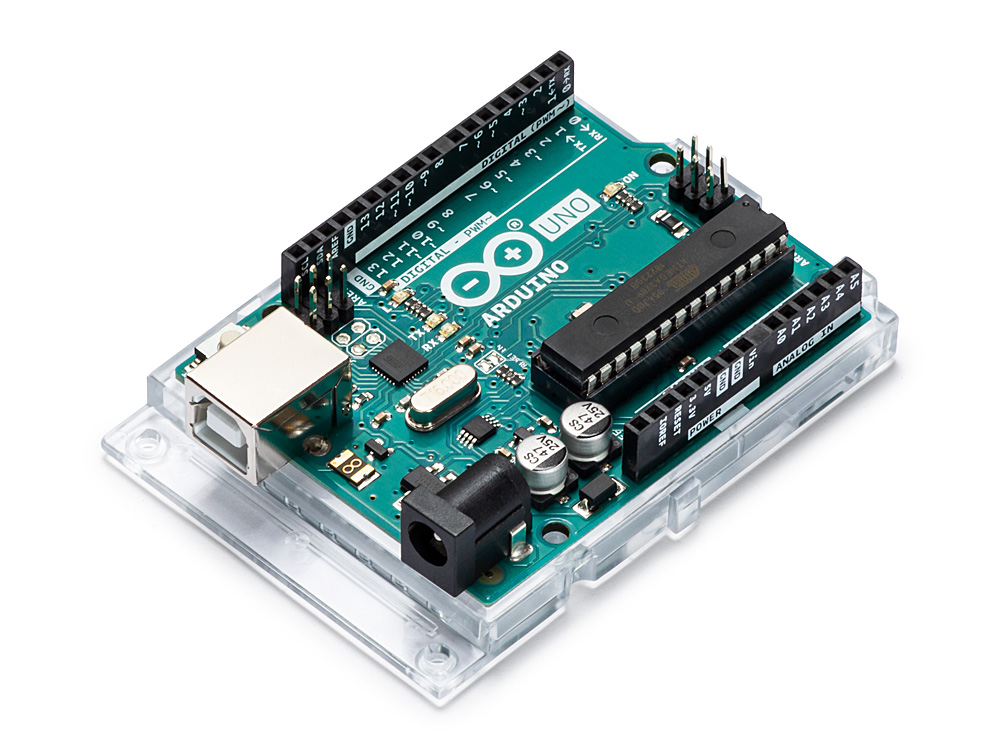
The Arduino Uno R3 is a microcontroller board based on a removable, dual-inline-package (DIP) ATmega328 AVR microcontroller. It has 20 digital input/output pins (of which 6 can be used as PWM outputs and 6 can be used as analog inputs). Programs can be loaded on to it from the easy-to-use Arduino computer program. The Arduino has an extensive support community, which makes it a very easy way to get started working with embedded electronics. The R3 is the third, and latest, revision of the Arduino Uno.
| Description | Specs (12) | Pictures (3) | Resources (11) | FAQs (0) | On the blog (3) | Distributors (0) |
|---|
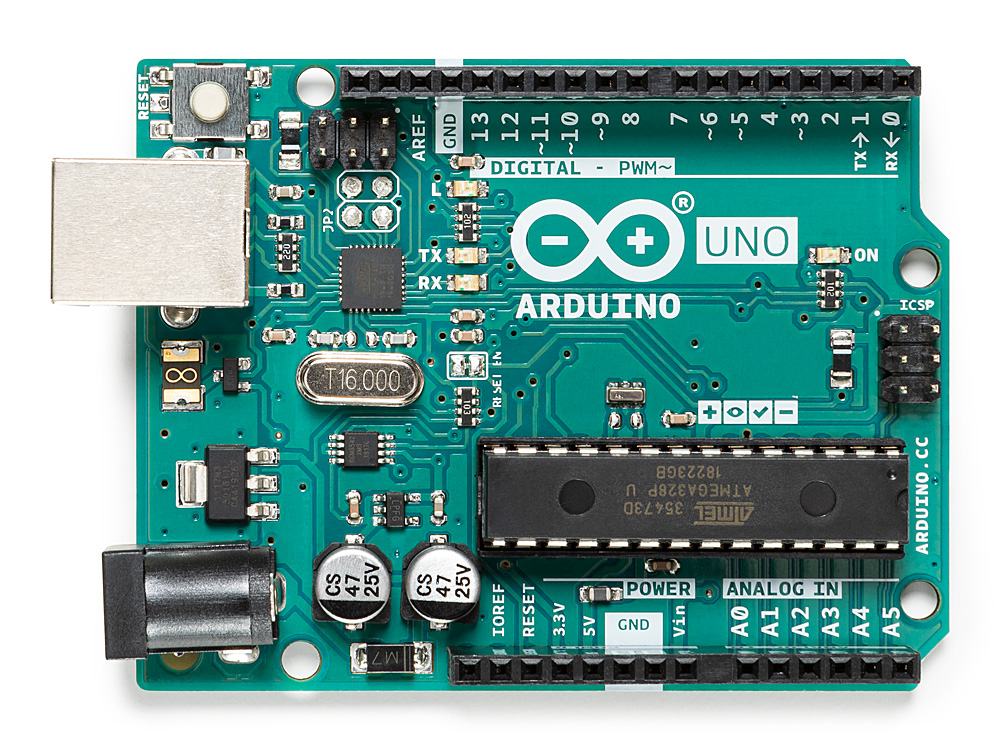 |
Arduino Uno R3, top view. |
|---|
Overview
The Arduino Uno is a microcontroller board based on the ATmega328. It has 20 digital input/output pins (of which 6 can be used as PWM outputs and 6 can be used as analog inputs), a 16 MHz resonator, a USB connection, a power jack, an in-circuit system programming (ICSP) header, and a reset button. It contains everything needed to support the microcontroller; simply connect it to a computer with a USB cable or power it with a AC-to-DC adapter or battery to get started.
The Uno differs from all preceding boards in that it does not use the FTDI USB-to-serial driver chip. Instead, it features an ATmega16U2 programmed as a USB-to-serial converter. This auxiliary microcontroller has its own USB bootloader, which allows advanced users to reprogram it.
The Arduino has a large support community and an extensive set of support libraries and hardware add-on “shields” (e.g. you can easily make your Arduino wireless with our Wixel shield), making it a great introductory platform for embedded electronics. Note that we also offer a SparkFun Inventor’s Kit, which includes an Arduino Uno along with an assortment of components (e.g. breadboard, sensors, jumper wires, and LEDs) that make it possible to create a number of fun introductory projects.
This is the 3rd revision of the Uno (R3), which has a number of changes:
- The USB controller chip changed from ATmega8U2 (8K flash) to ATmega16U2 (16K flash). This does not increase the flash or RAM available to sketches.
- Three new pins were added, all of which are duplicates of previous pins. The I2C pins (A4, A5) have been also been brought out on the side of the board near AREF. There is a IOREF pin next to the reset pin, which is a duplicate of the 5V pin.
- The reset button is now next to the USB connector, making it more accessible when a shield is used.
Warning: We recommend not connecting the Arduino to USB while it is powered through VIN. See this forum post for more information.
Choosing the right controller
The table below compares the Arduino Uno, Leonardo, and our A-Star 32U4 Prime controllers. The A-Star Primes are based on the same ATmega32U4 AVR microcontroller as the Leonardo and ship with Arduino-compatible bootloaders. The Primes also offer many advantages, including superior power management that enables efficient operation from 2.7 V to 11.8 V (LV version) or 5 V to 36 V (SV version).
 Arduino Uno R3 |
 Arduino Leonardo |
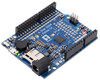 A-Star 32U4 Prime LV |
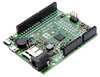 A-Star 32U4 Prime SV |
||
|---|---|---|---|---|---|
| Microcontroller: | ATmega328P | ATmega32U4 | ATmega32U4 | ||
| Clock: | 16 MHz resonator | 16 MHz crystal | 16 MHz crystal | ||
| User I/O lines: | 20 | 23 | 26 | ||
| PWM outputs: | 6 | 7 | 7 | ||
| Analog inputs: | 6 | 12 | 12 | ||
| Ground access points: | 4 | 4 | 43 | ||
| User LEDs: | 3 | 3 | 3 | ||
| User pushbuttons: | — | — | 3 | ||
| Reset button: |  |
|
|
||
| Power switch: | |
||||
| Buzzer option: | |
||||
| microSD option: | |
||||
| LCD option: | |
||||
| Arduino-compatible bootloader: |
|
|
|
||
| USB connector: | B | Micro-B | Micro-B | ||
| USB/regulator power selection: |
partial | partial | TPS2113A | ||
| High-performance reverse-voltage protection: |
|
||||
| Recommended input voltage: |
7 V to 12 V | 7 V to 12 V | 2 V to 16 V | 5 V to 36 V | |
| Regulator type (5 V): | linear | linear | switching step-up/step-down |
switching step-down |
|
| Available 5 V output current: |
at 3 V in | — | — | 0.75 A | — |
| at 5 V in | — | — | 1.5 A | 0.2 A | |
| at 7 V in | 1.0 A | 1.0 A | 1.9 A(1) | 1.0 A | |
| at 9 V in | 0.5 A | 0.5 A | 1.9 A(1) | 1.0 A | |
| at 11 V in | 0.35 A | 0.35 A | 1.8 A | 1.0 A | |
| at 24 V in | — | — | — | 1.0 A | |
| via USB connector |
0.5 A(2) | 0.5 A(2) | 1.9 A(3) | 1.9 A(3) | |
| Weight: | 28 g | 20 g | 13 g to 33 g | ||
| Price: | $27.60 | $24.95 | $33.40 to $53.00 | ||
| 1 There is more available 5 V output current via VREG, see maximum regulator output current graph for details. | |||||
| 2 With sufficient USB power supply. | |||||
| 3 Nominal current available through power MUX with sufficient USB power supply. | |||||
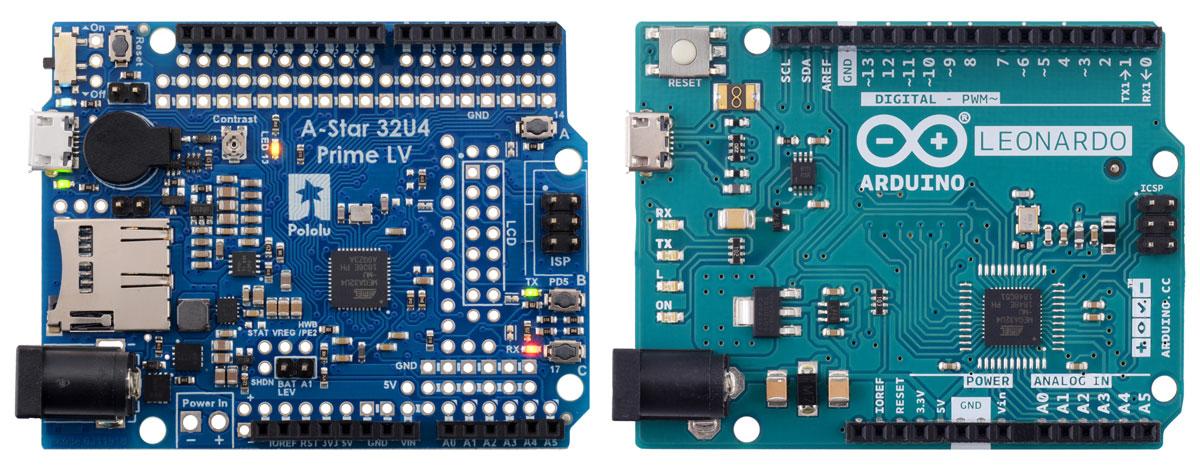 |
Side-by-side comparison of the A-Star 32U4 Prime LV microSD to the Arduino Leonardo. |
|---|
We also carry a variety of other programmable controllers, from the beginner-friendly BASIC Stamp to the far more capable mbed and Raspberry Pi boards, which are based on powerful ARM processors. Our full selection can be found in our Programmable Controllers category.
Related products


Related categories


Home | Forum | Blog | Support | Ordering Information | Lists | Distributors | BIG Order Form | About | Contact
© 2001–2026 Pololu Corporation