Arduino Due

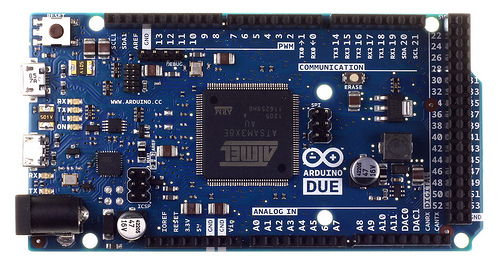
The Arduino Due is the first Arduino with an ARM-based microcontroller. It is based on the Atmel SAM3X8E ARM Cortex-M3 CPU that enables a higher level of performance compared to Arduinos with 8-bit microcontrollers. The Arduino Due has 54 digital input/output pins (of which 12 can be used as PWM outputs), 12 analog inputs, 4 UARTs (hardware serial ports), a 84 MHz clock, a USB OTG capable connection, 2 DAC (digital to analog converters), 2 TWI, a power jack, an SPI header, a JTAG header, and reset and erase buttons.
| Description | Specs (10) | Pictures (3) | Resources (15) | FAQs (0) | On the blog (2) | Distributors (0) |
|---|
 |
Note: There are differences between the Arduino Due and previous Arduino boards. As such, there could be incompatible Arduino shields and libraries. The Arduino Due works with our motor shields, though the motor driver shield current sense outputs can exceed the Due’s 3.3 V I/O pin limit at high currents. Please see the shield user’s guides for more details.
Overview
The Arduino Due is a microcontroller board based on the Atmel SAM3X8E ARM Cortex-M3 CPU. It is the first Arduino board based on a 32-bit ARM core microcontroller. It has 54 digital input/output pins (of which 12 can be used as PWM outputs), 12 analog inputs, 4 UARTs (hardware serial ports), a 84 MHz clock, a USB OTG capable connection, 2 DAC (digital to analog converters), 2 TWI, a power jack, an SPI header, a JTAG header, a reset button and an erase button. The Due is compliant with the Arduino 1.0 pinout; it has SDA and SCL pins near the AREF pin and an IOREF pin, which can be used by shields to detect the microcontroller board voltage.
Unlike many other Arduino boards, the Arduino Due board runs at 3.3 V. The maximum voltage that the I/O pins can tolerate is 3.3 V. Connecting higher voltages, like 5 V, directly to an I/O pin could damage the board. We recommend you use something like our bidirectional logic level shifter to interface this board with 5V systems.
The board contains everything needed to support the microcontroller; simply connect it to a computer with a micro-USB cable or power it with a AC-to-DC adapter or battery to get started.
The Arduino has a large support community and an extensive set of support libraries and hardware add-on “shields”, making it a great introductory platform for embedded electronics. Note that we also offer a SparkFun Inventor’s Kit, which includes an Arduino Uno along with an assortment of components (e.g. breadboard, sensors, jumper wires, and LEDs) that make it possible to create a number of fun introductory projects.
More information about the Arduino Due is available on Arduino’s website.
Summary
- Microcontroller: AT91SAM3X8E
- Operating voltage: 3.3 V
- Input voltage (recommended): 7-12 V
- Input voltage (limits): 6-20 V
- Digital I/O pins : 54 (of which 12 provide PWM output)
- Analog input pins: 12
- Analog outputs pins (DAC): 2
- Total DC output current on all I/O lines: 130 mA
- DC current for 3.3V pin: 800 mA
- DC current for 5V pin: 800 mA
- Flash memory: 512 KB all available for the user application
- SRAM : 96 KB (two banks: 64 KB and 32 KB)
- Clock speed: 84 MHz
Warning: We recommend not connecting the Arduino to USB while it is powered through VIN. See this forum post for more information.
Related products


Related categories


Home | Forum | Blog | Support | Ordering Information | Lists | Distributors | BIG Order Form | About | Contact
© 2001–2026 Pololu Corporation